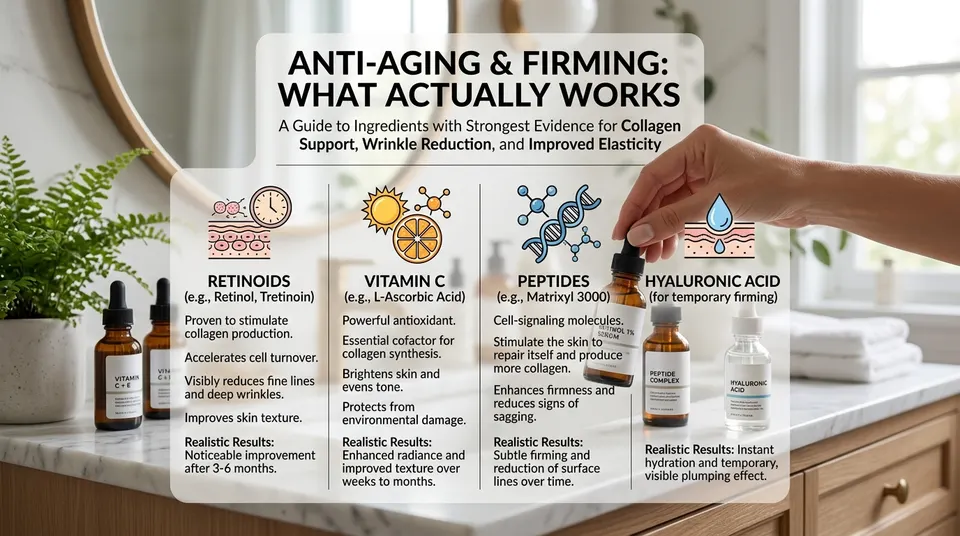
What Topical Products Can and Cannot Do
Skin aging has two main drivers. Intrinsic aging is the gradual decline in collagen production, reduced cell turnover, and slower repair that happens to everyone over time — mainly driven by hormonal changes and genetic programming. Extrinsic aging is caused by external factors, overwhelmingly UV exposure (photoaging), but also pollution, smoking, and repetitive facial expressions.
Topical products can meaningfully affect some aspects of extrinsic aging and can modestly support the skin's natural processes as intrinsic aging progresses. They cannot reverse deep wrinkles, restore lost facial volume, or tighten significant skin laxity — those changes happen below the dermis, where topical ingredients do not reach in meaningful concentrations. The distinction between what topical products can improve and what they cannot is the most useful thing to understand before spending money on anti-aging skincare.
Ingredients with the Strongest Evidence
Retinoids (Vitamin A Derivatives)
Retinoids are the most thoroughly studied class of anti-aging ingredients in cosmetic dermatology. They work by binding to retinoic acid receptors in skin cells, which triggers increased cell turnover, stimulates collagen production, and normalises the shedding of dead skin cells.
The evidence: Multiple controlled trials show that prescription tretinoin (0.05%) reduces fine wrinkling, improves skin roughness, and increases epidermal thickness over 24 to 48 weeks of regular use. Over-the-counter retinol is less potent — roughly one-tenth the strength of tretinoin per concentration — but still shows measurable improvements in fine lines and skin texture in studies lasting 12 to 24 weeks.
The practical difference between retinol and tretinoin: Tretinoin is the active form that binds directly to skin cell receptors. Retinol must be converted to retinoic acid by enzymes in the skin — a two-step conversion that reduces potency and slows the effect but also reduces irritation. Retinaldehyde (one conversion step closer than retinol) is a middle option. The hierarchy of potency: tretinoin > retinaldehyde > retinol > retinyl esters.
What realistic results look like: After three to six months of consistent use, fine lines (especially around the eyes and on the forehead) become less noticeable. Skin texture feels smoother. Pigmentation from sun damage fades. Deep wrinkles and sagging do not disappear — they appear less pronounced because the surrounding skin is firmer.
The tradeoff: Irritation is common — redness, peeling, dryness, and increased sensitivity to other products. This is called retinisation and typically lasts two to four weeks. Starting with a low concentration (0.3% retinol or lower) twice a week and gradually increasing frequency minimises irritation. Using a moisturiser with ceramides and a gentle cleanser alongside a retinoid is essential.
Vitamin C (L-Ascorbic Acid)
Vitamin C is an antioxidant that neutralises free radicals generated by UV exposure and pollution. It is also a co-factor for collagen synthesis — without sufficient vitamin C, collagen production slows regardless of how much collagen-boosting ingredient is applied.
The evidence: Studies using 10-20% L-ascorbic acid (the active form of vitamin C) show improvements in photoaging over 12 to 24 weeks — reduced fine lines, improved firmness, and more even skin tone. The effect is modest compared to retinoids but complementary. Vitamin C does not stimulate collagen production directly the way retinoids do; it enables the collagen synthesis that retinoids trigger.
Formulation matters critically: L-ascorbic acid is unstable in water and oxidises rapidly when exposed to air and light. Effective formulations use a low pH (below 3.5), opaque packaging, and stabilisation strategies like adding ferulic acid or vitamin E. An oxidised vitamin C serum (turned brown or amber) is ineffective. Anhydrous formulations (water-free) or stabilised derivatives (ascorbyl tetraisopalmitate, magnesium ascorbyl phosphate) are more stable but less well-studied for anti-aging effects.
What realistic results look like: Brighter, more even skin tone after four to eight weeks. Fine lines appear less prominent as collagen synthesis improves. The primary benefit is prevention rather than reversal — consistent vitamin C use over years slows the visible progression of photoaging.
Peptides
Peptides are short chains of amino acids that act as signalling molecules. When applied to the skin, certain peptides (particularly matrixyl — palmitoyl pentapeptide-4) can signal fibroblasts to produce more collagen and elastin.
The evidence: The evidence for peptides is weaker than for retinoids and vitamin C. Some controlled studies show modest improvements in wrinkle depth and skin firmness over 8 to 12 weeks, but the effects are small and not all peptide formulations have supporting data. The industry uses the term "peptide" broadly — a cream containing a single peptide at a low concentration is unlikely to produce the same results as one with multiple peptides at clinically studied levels.
The limitation: Peptides are large molecules that penetrate the skin poorly. Formulators use penetration enhancers and carrier systems to improve delivery, but the amount that reaches the target cells is a fraction of what was applied. Copper peptides (GHK-Cu) have additional wound-healing properties but can cause irritation when used alongside retinoids or acids.
What realistic results look like: Subtle improvements in firmness and reduction in fine lines over several months. Peptides work best as part of a broader anti-aging strategy — they are unlikely to produce visible results on their own in a person with significant photoaging.
Other Ingredients Worth Knowing
Niacinamide (Vitamin B3) improves skin barrier function, reduces pigmentation, and has anti-inflammatory effects. Its anti-aging effects are indirect — it supports the conditions in which collagen production happens rather than stimulating collagen directly. A 5% niacinamide formulation is the most widely studied concentration.
Growth factors are signalling proteins that regulate cell proliferation and repair. Topical growth factors (EGF, TGF, VEGF) show promise in clinical studies for improving skin thickness and reducing wrinkle depth, but the products are expensive, the evidence base is smaller than for retinoids, and the long-term effects are not fully understood.
AHAs (Alpha-Hydroxy Acids) — glycolic acid, lactic acid — exfoliate the outer layer of skin, improving texture and brightness. They do not stimulate collagen production directly but can enhance the penetration of other anti-aging ingredients. Regular use can reduce the appearance of fine lines by improving surface texture rather than changing the underlying structure.
The Role of Sunscreen
No anti-aging ingredient matters more than UV protection. UV exposure is responsible for approximately 80% of visible facial aging. A daily broad-spectrum sunscreen (SPF 30 or higher) prevents the collagen breakdown, elastin damage, and pigmentation changes that every other anti-aging product is trying to reverse. Without sunscreen, the effect of even the most expensive anti-aging routine is blunted by ongoing UV damage.
The practical implication: if you can only afford one anti-aging product, buy a good sunscreen. The best topical anti-aging routine is sunscreen in the morning and a retinoid at night, with a basic moisturiser and cleanser to manage irritation.
What Products Cannot Do
Topical products work in the epidermis and the upper dermis. They cannot:
Replace lost volume. Facial volume loss happens in the deep fat compartments of the face. The only way to restore it is injectable fillers or fat grafting.
Reverse significant sagging. Moderate to severe skin laxity requires tightening procedures — radiofrequency, ultrasound, or surgical lifting.
Eliminate deep wrinkles. Deep nasolabial folds, marionette lines, and crepey skin on the neck are structural changes that topical products cannot reach.
This is not an argument against topical anti-aging products. They produce genuine, visible improvements in the skin's surface condition. But realistic expectations matter — a retinoid will improve fine lines; it will not make a 60-year-old face look 30 again.
Common Misconceptions
"Collagen creams add collagen to your skin." Collagen molecules are too large to penetrate the skin. Applied collagen sits on the surface, where it acts as a humectant — it holds water but does not become part of your skin's structure. Collagen supplements taken orally may have a small effect on skin hydration, but the evidence is mixed and the effect size is small.
"More expensive products work better." Anti-aging efficacy depends on the active ingredient and its concentration, not the brand or the price. A well-formulated drugstore retinoid is more effective than an expensive peptide serum. Price correlates with packaging, fragrance, and marketing, not clinical results.
"You need a 10-step routine." The essential anti-aging routine has three steps: sunscreen in the morning, a retinoid at night, and a moisturiser as needed. Additional products (vitamin C, niacinamide, peptides) can add marginal benefits but are not required. More steps increase the risk of irritation and make the routine harder to maintain consistently — and consistency matters more than the number of products.
Compact Takeaway
Retinoids have the strongest evidence for improving fine lines, texture, and pigmentation — they are the foundation of any anti-aging routine. Vitamin C provides complementary antioxidant protection and supports collagen synthesis. Peptides offer modest additional benefits, but the evidence is weaker. Sunscreen is the single most important product for preventing visible aging — without it, no other ingredient can keep up with ongoing UV damage. Realistic expectations matter: topical products improve surface-level signs of aging but cannot replace volume, tighten laxity, or eliminate deep wrinkles. A consistent routine with sunscreen and a retinoid, supported by a simple moisturiser, outperforms an expensive 10-step routine used inconsistently.