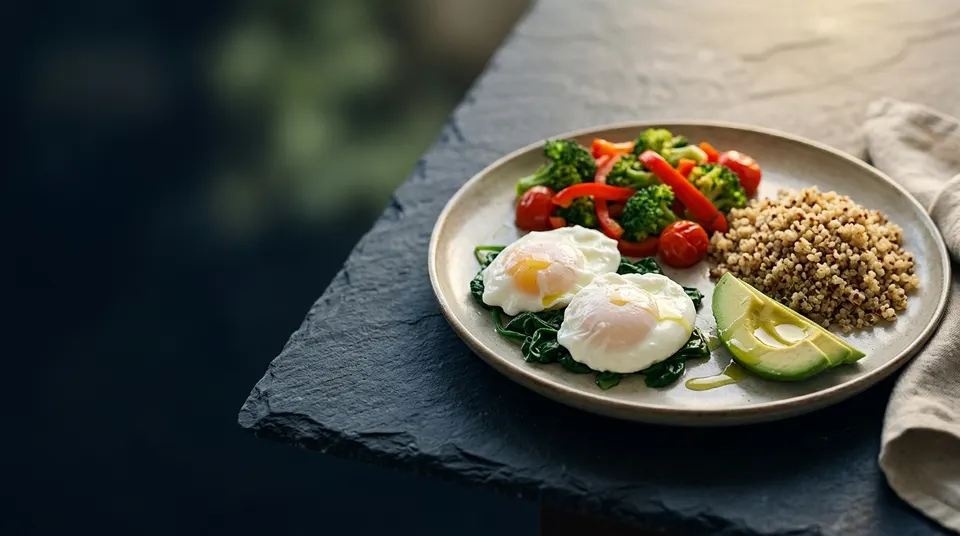

From Mechanism to Meal
The previous nodes explained why energy crashes happen. This one is the translation layer: how those mechanisms become a plate you can build in any kitchen, in any culture, without tracking anything.
The Four-Component Pattern
An energy-stable meal needs four things on the plate. Each one does a different job, and the jobs don't overlap — they work through two types of mechanisms.
Physical mechanisms create obstacles that slow glucose down before it reaches your blood: gels that thicken gut contents, solid threads that take time to push through, cell walls your digestive system has to break open. Hormonal mechanisms trigger signals that counterbalance insulin or tell your stomach to empty more slowly. Fiber is the only component that uses both. The others each specialize in one. That's why they stack instead of duplicate — you're applying four different brakes to the same process, not hitting the same brake four times.
Protein. Protein does two things that stabilize your energy, and carbohydrates alone can't do either of them. Both work through hormonal signals.
First, eating carbohydrates triggers insulin — the hormone that moves glucose out of your blood and into your cells. Protein triggers insulin too, but it also triggers a second hormone called glucagon. Think of insulin and glucagon as a seesaw: insulin lowers blood sugar, glucagon gently raises it. When you eat carbohydrates alone, insulin fires with nothing on the other side — it can push blood sugar too low, and you feel tired and hungry an hour later. Protein puts weight on the other side.
Second, protein triggers hormones that slow the rate at which food leaves your stomach. Slower stomach emptying means glucose enters your bloodstream gradually instead of all at once.
Aim for roughly 20–30 g at main meals — that's about two eggs and a yogurt, a chicken thigh, or a cup of lentils. The form doesn't matter: eggs, yogurt, fish, chicken, tofu, tempeh, lentils, chickpeas.
Fiber. Fiber physically slows how fast glucose enters your blood, and it does this in two ways.
Soluble fiber dissolves in water and forms a gel — think of how oats thicken in a pot, or how chia seeds turn liquid into a thick pudding. That gel makes the contents of your gut more viscous, so glucose moves through it more slowly, like trying to pour honey instead of water.
Insoluble fiber doesn't dissolve — it stays as solid threads, like the strings in celery or the skin on a bean. These threads take up space and give your digestive tract more material to physically push through, which slows the overall pace of digestion. One thickens the fluid, the other adds solid mass. Both slow glucose down, but through different physical routes.
You don't need to remember the names. Just know that vegetables, legumes, whole grains, and fruit contain both types, and eating them before carbohydrates flattens the glucose curve. Eat this component first — the reason why is in the next section.
A carbohydrate, preferably intact. The closer a carbohydrate is to its original physical structure, the slower it digests. A whole grain of rice still has its cell walls — the microscopic packaging around the starch inside. Your digestive system has to break through those walls first, and that takes time. When you grind rice into flour, you've already done that work: the walls are broken, the starch inside is exposed, and your gut can convert it to glucose almost immediately. The same applies to a whole potato versus instant mashed potato, or whole oats versus oat flour.
If you can see and feel the grain structure — if it has texture, chew, and bite — the cell walls are still doing their job. That physical structure is what slows the glucose release. Two foods can look identical on a nutrition label but behave very differently in your body if one is whole and the other has been ground to flour.
Fat. A modest amount of fat slows the entire meal down through a hormonal signal — roughly 10–15 g, which is a tablespoon of olive oil, a quarter avocado, the fat naturally in eggs or full-fat dairy, or a small handful of nuts.
When fat reaches your small intestine, it triggers a hormone that tells the valve between your stomach and intestine to slow down. Food releases more gradually into the intestine, which means the glucose from your carbohydrates arrives in a slow stream rather than a flood.
Once you recognize the pattern, scanning a plate takes about five seconds: is there protein? Something with fiber? What are the carbohydrates, and are they intact? Any fat? When one element is missing, you know what to add.
The One Free Upgrade: Eat in Order
The sequence in which you eat changes your glucose response — with no change to the food itself. Same meal, different order, measurably flatter curve.
Here's why it works, step by step.
When you eat vegetables first, their fiber creates a physical mesh in your stomach and intestine. This mesh slows down everything that comes after it — like a traffic bottleneck that backs everything up gently.
Your body also detects the fiber and releases hormones that slow stomach emptying. This happens within minutes — you don't need to wait half an hour between courses. Even two or three minutes of eating vegetables first is enough for the mesh to start forming and the hormonal signal to go out, before any carbohydrates arrive.
So by the time you eat the carbohydrates, your stomach is already in slow-release mode. The carbohydrates trickle into the intestine instead of flooding it, and glucose enters your blood over a longer window.
The result: eating vegetables first, then protein, then carbohydrates last reduces the post-meal glucose peak by 30–70% compared to eating carbohydrates first. In some studies, the upper end of that range means the spike is cut by more than half.
In practice:
Start with salad, soup, or cooked vegetables.
Eat the protein and remaining vegetables together through the middle of the meal.
Leave bread, rice, pasta, or potatoes for last.
You don't need to eat each component in isolation. The effect holds with a reasonable sequence. Just don't start with the bread.
The Day's Carbohydrate Arc
Your body handles the same carbohydrates better earlier in the day than late at night. This isn't about being active or sedentary — it's written into your cells.
Every cell in your body has an internal clock. One of the things this clock controls is how responsive your cells are to insulin — a measure called insulin sensitivity. When insulin sensitivity is high, your cells respond quickly to insulin's signal to take in glucose, and blood sugar clears efficiently. When it's low, the same signal is sluggish, and glucose stays in the blood longer.
Insulin sensitivity isn't constant across the day. There's a brief dip in the early morning — the dawn phenomenon, which the Breakfast node covers in detail — when cortisol and growth hormone make your cells temporarily less responsive. Once that dip resolves, sensitivity rises and stays strong through the middle of the day. From the afternoon onward, it declines steadily. So the same bowl of pasta that your cells clear smoothly at noon takes longer to clear at 9 p.m.
A rough arc that works for most people:
Morning: Sensitivity is recovering from the dawn dip and rising. Intact carbohydrates are well tolerated — this is a good window to front-load them if you want to.
Midday: Sensitivity is near its peak. Lunch can carry a meaningful carbohydrate portion.
Evening: Sensitivity is at its lowest. A large plate of refined carbs late at night has a measurably different effect on your body than the same plate at noon — not catastrophically different, but real. It also means your body is still digesting when it should be shifting toward sleep.
This is a gradient, not a rule. The arc matters as a pattern across weeks, not as a nightly compliance test.
The Post-Meal Walk
Walking after a meal lowers your blood sugar through a back door that doesn't involve insulin at all. This matters because it works even when insulin is struggling — for example, late at night when insulin sensitivity is low.
Here's the full chain:
Muscle contraction activates special gateways on the surface of muscle cells → these gateways pull glucose in from the blood, without needing insulin's signal → the post-meal glucose peak is lower → insulin doesn't have to work as hard → the risk of an overshoot drops.
A 10-minute walk within 30 minutes of a meal is enough. Even two minutes of standing and moving helps. The Midday Slump node explains why this simple habit fixes three separate causes of the afternoon slump.
How the Pattern Adapts Across Cuisines
The energy-smart pattern is a composition principle, not a cuisine. In traditional food cultures worldwide, the structure often exists already. In a traditional Japanese meal, miso soup and grilled fish provide protein, pickled vegetables provide fiber, and the rice bowl is eaten last. In a traditional Indian meal, dal and sabzi (protein and fiber) come first, roti or rice comes alongside or after, and ghee or cooking oil provides the fat. In Ethiopian cuisine, lentil and vegetable stews are eaten first and pieces of injera flatbread — the carbohydrate — are used to scoop them up, arriving last by convention.
Traditional food cultures arrived at this structure independently — the energy-smart plate isn't a new invention, it's a recognition of a pattern that already works.
Two Practical Scenarios
Eating out
Two moves handle most restaurant situations. Order a vegetable-based starter and eat it before the main — that's the food-order effect applied without any special behavior at the table. If bread arrives first, either hold off or eat it with olive oil, which provides some fat to slow the meal's pace. It won't fully undo eating the bread first, but it takes the edge off.
When options are limited
A convenience meal is not an energy disaster. It's one meal. When composition isn't ideal, partial application still helps:
No vegetables? Eat the protein first. Protein also triggers hormones that slow stomach emptying, so it partially mimics the food-order effect.
Everything refined? Eat slowly. Chewing and a slower pace extend the delivery window slightly.
No time for a walk? Stand up and move for two minutes. As explained above, any muscle contraction helps your muscles pull glucose from the blood directly.
What to Take Away
The energy-smart plate is four components — protein, fiber, intact carbohydrate, and a modest amount of fat — eaten in a sequence that puts fiber and protein first and carbohydrates last. The day's carbohydrate arc means leaning more of your carbs toward the first half of the day, when your cells handle them best. A post-meal walk adds a separate lever that works even when insulin is struggling. And the pattern works in any cuisine because it's a structural principle, not a specific food.
The scan takes five seconds. The order costs nothing.