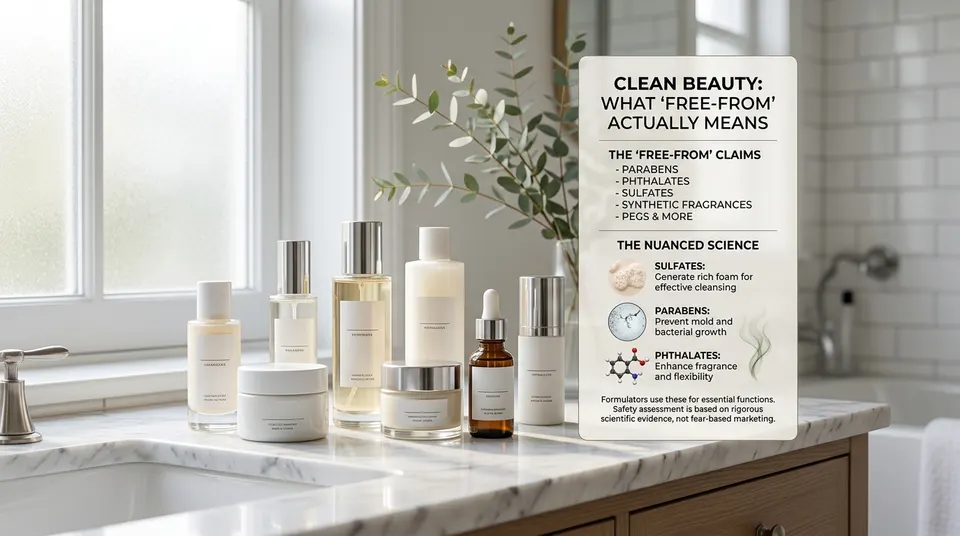
Why 'Free-From' Became the Standard Claim
The phrase "clean beauty" emerged in the 2010s as a consumer backlash against long, unpronounceable ingredient lists. The core idea — that products should exclude potentially harmful substances — is intuitively appealing. But "clean" has no regulated definition. It means whatever a brand wants it to mean, and what gets excluded varies from product line to product line.
The practical question is not whether a given ingredient sounds scary. It is what the ingredient actually does, why it is in cosmetics, and what the evidence says about safety at the concentrations used. Most of the commonly excluded substances have well-understood functions, clear safety profiles at cosmetic concentrations, and — in some cases — no widely available substitutes that perform the same job as effectively.
The Free-From Ingredients, One by One
Parabens
Parabens are preservatives — the most effective and best-studied class of cosmetic preservatives ever developed. They prevent bacterial, fungal, and mould growth in products that contain water, which is the vast majority of cosmetics. Without preservatives, a moisturiser or shampoo would be unsafe within days of opening.
The controversy around parabens began with a 2004 study that detected paraben residues in breast tumour tissue. The study did not demonstrate that parabens caused the tumours — only that they were present. The finding triggered a wave of consumer concern and a regulatory re-evaluation by the European Scientific Committee on Consumer Safety (SCCS), which concluded in 2013 that methylparaben and ethylparaben are safe at concentrations up to 0.4% each. Longer-chain parabens (propylparaben, butylparaben) were restricted due to weaker estrogenic activity, not because they were proven dangerous.
The risk profile in context: parabens have roughly 10,000 to 100,000 times weaker estrogenic activity than the body's own estradiol — the primary human estrogen. Soy, which is consumed in food daily, has measurable estrogenic activity orders of magnitude stronger than parabens at cosmetic concentrations.
The practical reality: paraben-free products must use alternative preservative systems — phenoxyethanol, benzyl alcohol, sorbic acid, or sodium benzoate. These are generally safe but often have narrower antimicrobial spectra, require higher concentrations, or cause more skin irritation than parabens. The switch to "paraben-free" was a marketing response to consumer demand, not a safety-driven reformulation.
Phthalates
Phthalates are a family of chemicals used as plasticisers and fragrance ingredients. The specific phthalates relevant to cosmetics — DEP (diethyl phthalate) and DBP (dibutyl phthalate) — are used to make fragrances last longer and to prevent nail polish from chipping.
Phthalates have been the subject of extensive regulatory scrutiny. In the EU, DBP and DEHP (a plasticiser used outside cosmetics) are banned from cosmetics. DEP is restricted but still permitted. The concern centres on certain phthalates' potential endocrine-disrupting effects, based primarily on animal studies at high doses.
The distinction that matters: not all phthalates are the same. The ones with the strongest evidence for health concerns — DEHP and DBP — are already banned or severely restricted in cosmetic regulation. DEP, which remains in some fragrances, has a different safety profile and is considered safe at cosmetic concentrations by regulatory bodies including the EU SCCS and the US Cosmetic Ingredient Review panel.
The label claim "phthalate-free" usually refers to all phthalates. In practice, most major brands stopped using the restricted ones voluntarily years before regulations caught up. The claim is increasingly redundant for products sold in regulated markets.
Sulfates (SLS and SLES)
Sodium lauryl sulfate (SLS) and sodium laureth sulfate (SLES) are surfactants — cleansing agents that remove oil and dirt by reducing the surface tension between water and your skin. They are the reason shampoo lathers.
The concern about sulfates is that they can be stripping — removing too much of the skin's natural sebum, which can cause dryness, irritation, and barrier disruption, especially for people with sensitive skin or conditions like eczema. This is a real effect, but it is about dose and individual sensitivity, not toxicity.
SLS is a known irritant at high concentrations — the Cosmetic Ingredient Review has established that concentrations above 2% can cause irritation in sensitive individuals. In most leave-on products (lotions, creams), SLS is used below this threshold. In rinse-off products (shampoos, body washes), it is typically at 5-15% but is in contact with skin for seconds rather than hours.
SLES, which is SLS reacted with ethylene oxide, is less irritating than SLS because the ethoxylation makes the molecule larger and less able to penetrate the skin. The concern about SLES is not irritation but contamination with 1,4-dioxane — a byproduct of the ethoxylation process that is classified as a probable human carcinogen. Reputable manufacturers purify their SLES to remove 1,4-dioxane to trace levels. The risk depends on the manufacturer, not the ingredient itself.
Sulfate-free alternatives use milder surfactants — coco-glucoside, decyl glucoside, sodium cocoyl isethionate, and others. These are genuinely less stripping, which makes them a reasonable choice for people with dry or sensitive skin. But they are less effective at removing oil, meaning people with oily hair or scalp often need to wash more frequently. The choice is a functional tradeoff, not a safety decision.
Synthetic Fragrances
"Fragrance" or "parfum" on an ingredient list is a single term that can represent dozens of individual chemicals. Regulatory bodies allow this because fragrance formulations are considered trade secrets. The practical consequence is that consumers cannot know which specific molecules are in the product — and some of those molecules are common allergens.
The EU requires labelling of 26 known fragrance allergens (increased to approximately 80 under recent updates) when they exceed certain concentrations. These include common sensitisers like limonene, linalool, citronellol, geraniol, and eugenol. About 1-3% of the general population has contact allergy to one or more fragrance allergens — the most common cause of cosmetic contact dermatitis.
"Fragrance-free" or "unscented" mean different things. Fragrance-free means no fragrance ingredients are added. Unscented means fragrance has been added to mask the base odour of the product — these products can still contain fragrance chemicals and trigger allergic reactions.
The tradeoff: unscented products have no masking fragrance, so they smell like their raw ingredients — which is often unpleasant. Manufacturers of fragrance-free products must use higher-quality base ingredients or accept that the product has a perceptible natural odour. Neither option is wrong; they are different choices for different priorities.
PEGs (Polyethylene Glycols)
PEGs are petroleum-based compounds used as thickeners, solvents, softeners, and moisture carriers. A PEG with a number — PEG-40, PEG-100 — indicates the molecular weight, which determines the function. Lower numbers act as humectants; higher numbers as thickeners.
The concern around PEGs centres on two issues: potential contamination with ethylene oxide (a known human carcinogen) and 1,4-dioxane (the same byproduct that affects SLES). Again, the risk depends on manufacturing quality — reputable suppliers purify PEGs to remove these contaminants to trace levels.
The second concern is that PEGs are "penetration enhancers" — they can help other ingredients absorb through the skin. In theory, this could increase absorption of undesirable substances. In practice, PEGs are used in many products precisely because they improve delivery of beneficial ingredients. The effect is the same regardless of whether the ingredient being delivered is good or bad — which means the concern depends on the formulation, not the PEG itself.
The evidence does not support avoiding PEGs as a class. The relevant question is whether the specific product uses high-quality, purified PEGs from reputable manufacturers — which is essentially unanswerable from the label alone.
Other Common Free-From Claims
Silicones (dimethicone, cyclomethicone, amodimethicone) are used for slip, smoothness, and shine. They are safe but not biodegradable, which is a legitimate environmental concern for rinse-off products. They can also build up on hair, requiring stronger cleansers to remove.
Mineral oil is highly purified petroleum-derived oil. It is an excellent moisturiser and one of the least allergenic cosmetic ingredients ever tested — it has essentially zero sensitisation potential. The concern is environmental (petroleum sourcing) and cosmetic (some people dislike the heavy feel), not safety.
Aluminium in antiperspirants blocks sweat ducts temporarily. The concern about aluminium and breast cancer has been thoroughly studied; the consensus of major cancer research organisations is that there is no established link. The EU SCCS has repeatedly confirmed aluminium compounds are safe at cosmetic concentrations.
The Pattern Behind Free-From Marketing
Most free-from ingredients share a common trajectory. An ingredient is used for decades with an established safety profile. A single study raises a theoretical concern, often at unrealistically high doses or in animal models. The concern is amplified by marketing, picked up by consumers, and becomes a reason to avoid the ingredient. Regulatory bodies review the evidence, often re-confirm safety with minor restrictions, but the consumer perception has already shifted.
This is not to say that all free-from claims are meaningless. Some replacements are genuinely better — milder surfactants for sensitive skin, fragrance-free products for allergy-prone individuals. The problem is the blanket assumption that "free-from" equals safer. It does not.
The most practical framework: ask what the ingredient does. If it is a preservative, there is a replacement — but the replacement may have a weaker safety record. If it is a surfactant, the replacement may be gentler but less effective. If it is a fragrance, the replacement is no fragrance at all, which changes the product experience. None of these decisions is about safety alone. They are about tradeoffs — and consumer-facing marketing tends to present only one side.
Clean Beauty Across Regulatory Frameworks
In the EU, the Cosmetics Regulation already bans over 1,300 ingredients from cosmetics — including many of the substances that "free-from" marketing claims to avoid. When a product sold in the EU advertises itself as paraben-free or phthalate-free, it is claiming to exclude ingredients that most products in the same category already exclude, either by regulation or by voluntary industry phase-out.
In markets with weaker regulation, the same claims carry more information. A paraben-free claim in the US or China tells you something genuine about the formulation — the manufacturer chose to exclude a class of preservatives that remains widely used. But the scientific question — whether the replacement is safer — remains the same regardless of market.
The irony is that the most rigorous certification for "clean" cosmetics — COSMOS, Ecocert, Natrue — does not simply ban individual ingredients. It sets formulation standards: minimum percentages of natural ingredients, restrictions on processing methods, and — crucially — full ingredient disclosure. These standards are more informative than any single free-from claim because they describe what is in the product rather than what was left out.
Common Misconceptions
"Natural ingredients are safer than synthetic ones." Poison ivy is natural. Arsenic is natural. Safety depends on the specific molecule and the dose, not whether it came from a plant or a laboratory. Many natural ingredients are common allergens; many synthetic ingredients are chemically identical to natural ones.
"If I can't pronounce it, I shouldn't put it on my skin." Tocopheryl acetate is vitamin E. Ascorbyl tetraisopalmitate is a stabilised form of vitamin C. Many essential ingredients have long chemical names. Pronounceability is not a safety metric.
"Free-from products are better for the environment." Not automatically. The replacement ingredient may require more land, water, or energy to produce; it may have a worse biodegradability profile; it may require more packaging to stabilise the formulation. Each ingredient substitution has its own environmental footprint, which is rarely disclosed on packaging.
Compact Takeaway
The "clean" and "free-from" movement has raised genuine awareness about cosmetic ingredients, which is positive. But individual free-from claims are not a reliable guide to safety or quality. Parabens are the best-studied preservatives available; sulfates are functional ingredients with a dose-dependent irritation profile; synthetic fragrances are the most common cosmetic allergen but affect a small minority; PEGs are manufacturing aids whose risk depends on purification quality, not the molecule itself. The most actionable approach is to read certifications rather than free-from lists — COSMOS and Ecocert tell you more about what is actually in the bottle than the absence of any single ingredient.