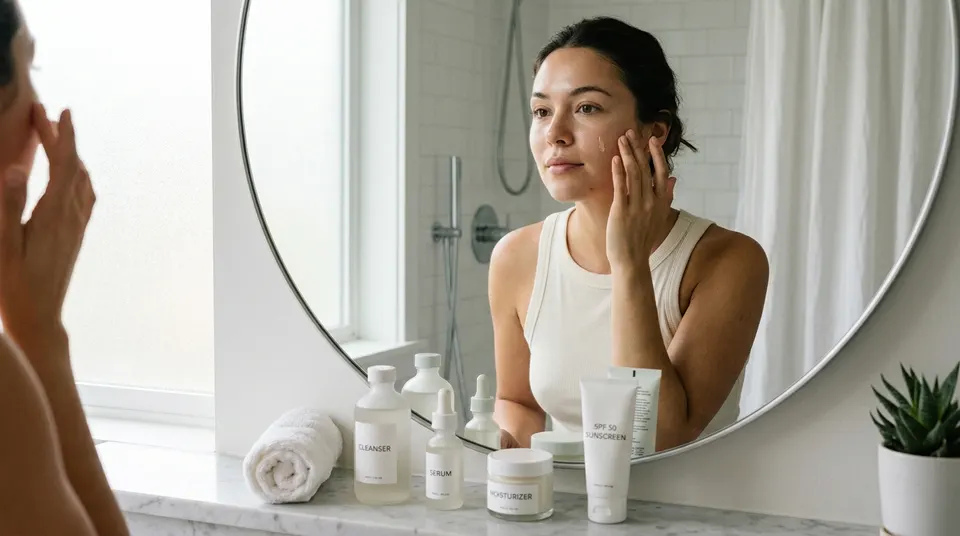
Why Facial Care Is Different
Facial skin differs from the rest of the body in several ways that matter for product choice. It has more sebaceous glands per square centimetre — which means it gets oilier but also benefits from lipid-supporting ingredients that body skin does not need. It is exposed to UV radiation every day, unlike most body skin. And it is the area where people use the most active ingredients — retinoids, acids, vitamin C — which makes the barrier more likely to be compromised by over-treatment.
A good facial routine is not about the number of products. It is about covering the essential functions — cleansing, treating, moisturising, protecting — with products that match your skin's current condition, without adding unnecessary steps that increase irritation or cost.
The Essential Categories
Cleansers
Cleansers remove dirt, oil, sweat, makeup, and pollutants from the skin surface. Their primary function is to prepare the skin for subsequent products — if the surface is not clean, nothing applied afterwards penetrates evenly.
The main types:
Oil cleansers and balms dissolve sebum and oil-based impurities (sunscreen, makeup) through the principle of like dissolves like. They are rubbed onto dry skin, emulsified with water, and rinsed off. Best as a first step in double-cleansing or for removing heavy makeup.
Micellar water contains micelles — tiny surfactant spheres that trap oil and dirt without requiring rinsing. It is the gentlest cleansing format and useful for situations where water is not available, but it does not remove heavy makeup or water-resistant sunscreen as effectively as an oil cleanser.
Foaming and gel cleansers use surfactants (SLS, SLES, or milder alternatives like coco-glucoside) to lift oil and debris from the skin. Foaming cleansers are effective for oily skin but can be stripping for dry or sensitive skin if the surfactant system is too harsh. Gel cleansers with milder surfactants are a safer default.
Cream and milk cleansers are non-foaming. They cleanse through emulsification rather than surfactant action, leaving more of the skin's natural lipids intact. Best for dry, sensitive, or compromised skin.
The practical rule: if your skin feels tight or stings after cleansing, your cleanser is too strong for your current barrier condition. Switch to a gentler format or reduce cleansing frequency.
Double cleansing — using an oil-based cleanser first, then a water-based cleanser — is useful for removing sunscreen and makeup thoroughly. For most people in the morning, a single gentle cleanse is sufficient. Double cleansing at night when makeup or water-resistant sunscreen has been worn is a reasonable approach — but for many skin types, a single effective cleanser is enough.
Moisturisers
A moisturiser provides water (through humectants), smoothness (through emollients), and barrier protection (through occlusives). The right moisturiser for your face depends primarily on your skin's current hydration and barrier status, not on your skin type label.
For a detailed breakdown of humectants, emollients, and occlusives — and how to read a moisturiser label to determine which category dominates — see the Hydration & Moisture objective module. The key facial-specific considerations are:
Oily or acne-prone skin needs a lightweight, humectant-dominant product with a minimal occlusive (dimethicone, squalane). Heavy creams with petrolatum or shea butter can feel occlusive enough to trap heat and increase perceived oiliness.
Dry or mature skin benefits from an emollient-rich product with a meaningful occlusive component. The skin's natural lipid production declines with age, and external lipid replacement becomes more important.
Compromised or sensitised skin — from retinoids, acids, or environmental exposure — needs a moisturiser formulated for barrier repair: ceramides, cholesterol, free fatty acids in a 1:1:1 ratio, applied to damp skin and sealed with an occlusive if needed.
Treatments and Serums
Serums are concentrated formulations of active ingredients designed to penetrate deeper than a moisturiser can. They are optional — a basic routine of cleanser, moisturiser, and sunscreen covers the essential functions. Serums add targeted benefits for specific concerns.
The most common serum categories and their evidence are covered in the Component modules:
Retinol — the gold standard for anti-aging. See the Retinol component module for potency hierarchy, retinisation management, and the sandwich method.
Vitamin C — antioxidant protection and collagen support. See the Vitamin C module for formulation requirements, derivative comparison, and morning application protocol.
Peptides — gentle, indirect collagen support. See the Peptides module for the four functional types, evidence assessment, and combination strategies.
A practical rule: introduce one serum at a time, use it for eight to twelve weeks before evaluating results, and do not layer more than two active products in the same routine without understanding how they interact.
Sunscreens
Sunscreen is the single most important product in any facial routine. UV exposure is responsible for approximately 80% of visible facial aging, and no active ingredient can compensate for ongoing UV damage. The facial-specific considerations are covered in detail in the dedicated sun protection module (Sunscreen product category, to be covered separately), but the essentials are:
Broad-spectrum protection — UVA and UVB. SPF measures only UVB protection. A broad-spectrum or UVA-circle label confirms UVA coverage.
SPF 30 or higher for daily use. SPF 30 blocks about 97% of UVB; SPF 50 blocks about 98%. The difference is smaller than the numbers suggest, but SPF 30 is the evidence-based minimum for meaningful protection.
Application matters more than the number. Most people apply less than half the amount needed to achieve the labelled SPF. A generous, even application of SPF 30 outperforms a thin layer of SPF 50.
Building a Routine
A minimal effective facial routine has three steps:
Cleanse — once or twice daily, depending on your skin's oiliness and makeup use. Over-cleansing damages the barrier.
Moisturise — after cleansing, while the skin is still slightly damp. This traps water in the skin and maintains barrier function.
Protect — sunscreen in the morning, every day, regardless of weather or indoor/outdoor status. UV penetrates clouds and windows.
From this baseline, you can add targeted treatments based on your specific concerns:
Anti-aging focus: Add a retinoid at night (after cleansing, before moisturiser, on dry skin). Add vitamin C in the morning under sunscreen for antioxidant protection.
Brightening focus: Add vitamin C in the morning. Consider niacinamide (5%) in the evening if pigmentation is a concern.
Acne focus: Add a leave-on BHA (salicylic acid) or a retinoid. Avoid over-exfoliating — more actives do not clear acne faster and usually make it worse.
Sensitive or barrier-focus: Keep the routine to three steps. Add a barrier-supporting serum (with ceramides, panthenol, or centella) if needed. Avoid all actives until the barrier recovers.
Common Mistakes
Using too many products. More steps do not produce better results. Each additional product increases the risk of irritation, reduces compliance, and makes it harder to identify which product is causing a problem if one arises. Three well-chosen products outperform ten poorly chosen ones.
Applying products in the wrong order. The general rule: thinnest to thickest consistency. Cleanser first, then water-based serums, then oil-based products, then moisturiser, then sunscreen. Applying a thick cream before a thin serum prevents the serum from penetrating.
Ignoring the neck and décolletage. The skin on the neck has a different structure than facial skin — it is thinner and produces less sebum — but it is exposed to the same UV and environmental damage. Extending your routine to the neck and upper chest prevents the visible mismatch that develops when the face is treated but the neck is not.
Buying based on texture rather than function. The feel of a product in the jar or on your skin tells you nothing about its efficacy. A moisturiser that feels luxuriously smooth may be mostly silicones and fragrance with minimal active ingredients. A plain-looking gel may contain clinically studied concentrations of barrier lipids. Judge products by their ingredient lists and your skin's response, not by the sensory experience.
Compact Takeaway
A facial routine needs only three essential steps — cleanse, moisturise, protect — plus optional targeted treatments based on specific concerns. Choose a cleanser that does not leave your skin tight, a moisturiser matched to your barrier condition, and a broad-spectrum sunscreen used daily. Add serums one at a time, evaluate results after two to three months, and prioritise consistency over complexity. The neck and chest deserve the same care as the face. The order of application matters — thinnest to thickest. When in doubt, fewer products are better than more.