Why Hydration and Moisture Are Not the Same Thing
In skincare marketing, "hydrating" and "moisturising" are used interchangeably. In formulation science, they describe different mechanisms — and the distinction matters when you are trying to fix a specific skin concern.
Hydration refers to the water content of the skin. A dehydrated skin lacks water. It feels tight, looks dull, and shows fine lines more prominently — especially on the forehead and cheeks. Hydration is about getting water into the skin.
Moisture refers to the oil and lipid content of the skin. A dry skin lacks oil. It feels rough, flakes, and has a compromised barrier. Dryness is a skin type (genetically determined). Dehydration is a skin condition (temporary and fixable). You can be oily and dehydrated at the same time — your skin produces excess sebum but still lacks water. That combination is common and explains why a heavy cream can feel wrong on dehydrated oily skin.
The distinction is practical: hydrating ingredients add water; moisturising ingredients prevent water loss and smooth the surface. Most products combine both, but the ratio determines which skin concerns they address best.
The Three Categories
Every moisturising product in existence uses ingredients from one or more of three functional categories. Understanding them lets you read any moisturiser label and understand what it will actually do.
Humectants: The Water Attractors
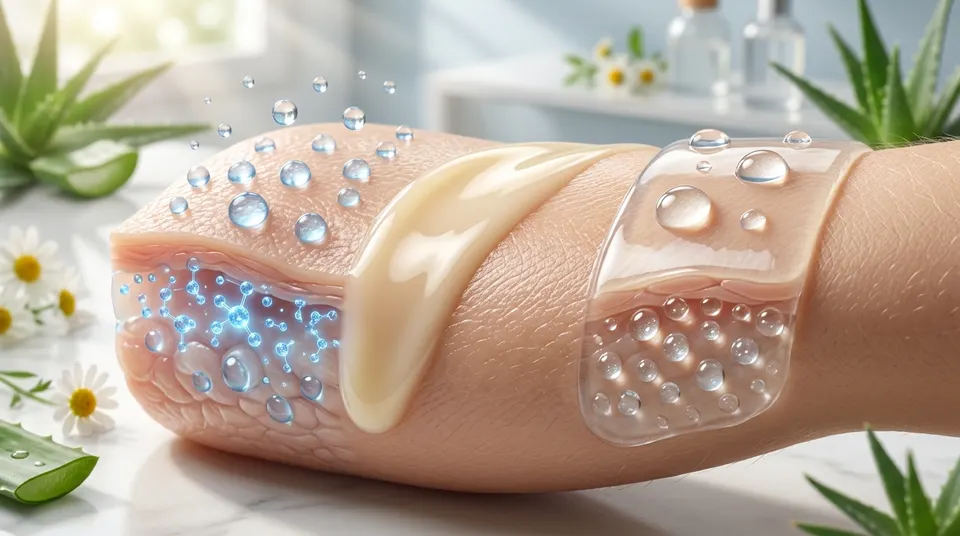
Humectants are molecules that draw water from the environment and from deeper layers of the skin into the outer layer (the stratum corneum). They increase the water content of the skin directly.
How they work: Humectants have hygroscopic properties — their molecular structure contains hydroxyl groups that form hydrogen bonds with water molecules. When applied to the skin, they create a concentration gradient that pulls water toward the surface. In humid conditions, they also absorb water from the air.
Common humectants: Glycerin (the most effective and best-studied humectant — present in virtually every moisturiser on the market), hyaluronic acid (a naturally occurring glycosaminoglycan that can hold up to 1,000 times its weight in water), urea, lactic acid, propylene glycol, butylene glycol, sorbitol, and aloe vera.
The limitation: In very dry environments (low humidity, heated indoor air, winter climates), humectants can actually draw water from the deeper layers of the skin to the surface, where it then evaporates. This is why humectants alone can paradoxically worsen dryness in arid conditions — they need to be paired with an occlusive to trap the water they bring up.
What to look for: Glycerin should be among the first five ingredients in any hydrating product. Low-molecular-weight hyaluronic acid penetrates better than high-molecular-weight versions. Multi-molecular-weight hyaluronic acid formulations (containing both low and high molecular weights) provide hydration at multiple skin depths.
Emollients: The Surface Smoothers
Emollients fill the gaps between skin cells, smoothing the surface and making the skin feel softer and more flexible. They do not add water — they improve how the skin feels and functions.
How they work: The outer layer of your skin is composed of corneocytes (dead skin cells) embedded in a lipid matrix — often described as a brick wall, where the cells are bricks and the lipids are mortar. Emollients fill the microscopic gaps between these cells, flattening the surface and improving the barrier's flexibility. They reduce transepidermal water loss indirectly by improving the barrier structure, but their primary effect is on texture, not water content.
Common emollients: Squalane (a hydrocarbon that mimics the skin's natural sebum), esters (isopropyl myristate, cetearyl ethylhexanoate), plant oils (jojoba, shea butter, sunflower), fatty alcohols (cetyl alcohol, stearyl alcohol — which are emollients, not drying alcohols), dimethicone and other silicones, and ceramides (which also function as barrier repair ingredients).
The texture tradeoff: Emollients vary widely in how they feel on the skin. Squalane is light and fast-absorbing. Shea butter is rich and leaves a visible film. Dimethicone gives a silky, velvety finish. The choice between them is cosmetic preference, not efficacy — a well-formulated product can use any of these.
What to look for: For oily or acne-prone skin, lighter emollients like squalane, caprylic/capric triglyceride, or dimethicone are better choices. For dry or mature skin, richer emollients like shea butter or plant oils provide more sustained smoothing.
Occlusives: The Barrier Sealers
Occlusives form a physical film on the surface of the skin that slows water evaporation. They are the ingredient category that most directly addresses transepidermal water loss (TEWL) — the natural process by which water evaporates from the skin into the environment.
How they work: Occlusives are hydrophobic substances — they repel water. Applied to the skin, they create a thin, continuous film that increases the distance water molecules must travel to reach the air, drastically slowing evaporation. The effect is purely physical, not biological.
Common occlusives: Petrolatum (the gold standard — reduces TEWL by over 98% in controlled studies), mineral oil, dimethicone, lanolin, beeswax, carnauba wax, and plant butters (shea, cocoa, mango). Petrolatum is so effective that it is used in burn units to prevent fluid loss from damaged skin.
The limitation: Occlusives feel heavy. Petrolatum is greasy. Beeswax can feel stiff. This is a genuine functional tradeoff — the most effective occlusive is also the least cosmetically elegant. Formulators balance occlusive power with texture by blending occlusives with lighter emollients and using silicones, which provide moderate occlusion with a much more pleasant feel.
What to look for: If your skin is very dry or your barrier is compromised (over-exfoliation, retinoid use, harsh weather), a product with a meaningful occlusive component — petrolatum, dimethicone, or a high-percentage plant butter — is worth prioritising. If your skin is normal to oily, a light occlusive like dimethicone is usually sufficient.
How to Read a Moisturiser Label
Ingredients are listed in descending order by weight. The first few ingredients determine the product's primary function.
Humectant-dominant products — hydrating serums, gel creams — list glycerin or hyaluronic acid near the top, with minimal emollients and occlusives. These feel light and absorb quickly. Best for dehydrated but not dry skin.
Emollient-dominant products — lotions, fluid creams — list oils, esters, or silicones prominently alongside a humectant. These balance hydration with surface smoothing. The standard choice for normal to combination skin.
Occlusive-dominant products — balms, heavy creams, ointments — list petrolatum, waxes, or butters high on the ingredient list. These are the most effective at preventing water loss. Best for dry skin, compromised barriers, or overnight use.
A practical rule: humectants hydrate but can backfire in dry air. Emollients smooth but do not hydrate. Occlusives seal but feel heavy. Most people need a combination — usually a humectant-dominant layer under an occlusive layer — but the ratio depends on your skin's current condition, not its label.
When the Category Matters Most — and When It Matters Less
The humectant-emollient-occlusive framework matters most when you are choosing products for a specific skin condition. Dehydrated skin needs humectants. Dry skin needs occlusives. Rough texture needs emollients. Most products combine all three, but knowing which category is dominant lets you match the product to the problem.
It matters less for people whose skin is balanced and not exposed to extreme weather or stripping routines. A standard moisturiser with all three categories will maintain good skin health without needing to optimise the ratio. But if you have specific concerns — flaking, tightness, oiliness with dehydration — the framework becomes genuinely useful.
Common Misconceptions
"Glycerin is a cheap filler." Glycerin is the single most effective humectant in cosmetic chemistry. It is cheap because it works and is abundant. Its low cost is a sign of efficiency, not inferiority.
"Hyaluronic acid is the best hydrator." Hyaluronic acid is effective, but its performance depends heavily on molecular weight and humidity. In low humidity, it can draw water from the skin rather than the air. Glycerin performs more consistently across environmental conditions. The idea that hyaluronic acid is always superior is largely driven by marketing — both are useful, and a product containing both is better than one containing either alone.
"Oily skin doesn't need moisturiser." Oily skin can be dehydrated — producing excess sebum while lacking water. A lightweight humectant-dominant product with a minimal occlusive (like dimethicone) improves hydration without adding oiliness. Skipping moisturiser entirely can worsen dehydration, which triggers more sebum production as a compensatory mechanism.
"Natural oils are always better than silicones." Silicones provide excellent occlusion with a silky, non-greasy feel. Many natural oils are less effective occlusives and can be comedogenic for some skin types. The choice depends on your skin, not on the ingredient's origin.
Compact Takeaway
All moisturising ingredients fall into three functional categories. Humectants (glycerin, hyaluronic acid) draw water into the skin — essential for hydration but potentially drying in arid conditions without an occlusive. Emollients (squalane, esters, shea butter) smooth the surface and improve barrier flexibility. Occlusives (petrolatum, dimethicone, waxes) seal water in by forming a physical film. Most products combine all three, but the dominant category determines what the product actually does for your skin. Match the dominant category to your current skin condition, not your skin type label, and read the first few ingredients to determine which category dominates.