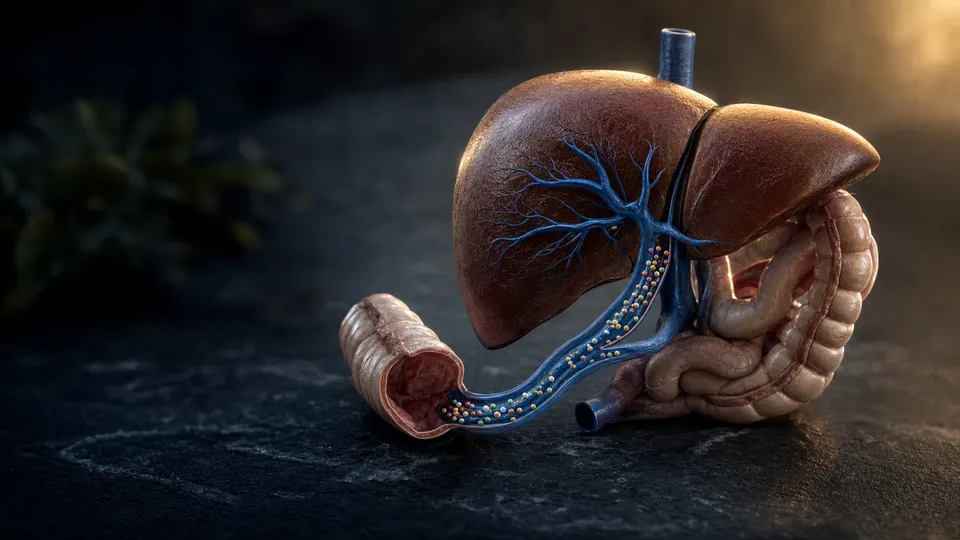
Why Your Liver Matters
Your liver processes almost everything you eat and drink — nutrients, alcohol, medications, and the byproducts of normal metabolism. It stores energy, makes essential proteins, and filters your blood. Unlike your heart or lungs, you don't feel it working until something goes wrong, which is exactly why the connection between your eating patterns and liver health is worth understanding.
Every meal sends compounds to your liver for processing. Over time, the patterns you build around food and drink directly shape how well your liver functions. Your liver can regenerate damaged tissue — but resilience has limits. Regular overloading from alcohol, excess sugar, or excess calories causes damage that accumulates silently.
Where the Liver Fits in Your Body's Pipeline
Your liver doesn't work in isolation. It sits at a critical junction: between your digestive system and the rest of your circulation.
When you eat, nutrients are absorbed through your intestinal wall and collected into the portal vein — a blood vessel that carries everything you've just absorbed directly to your liver before it reaches any other organ. Your liver is the first to process what you've eaten. It acts as a gatekeeper: deciding what gets stored, what gets converted, what gets sent out to the rest of your body, and what gets neutralized and removed.
This arrangement is called first-pass metabolism. Your liver gets the first look at everything you absorb, and it processes or neutralizes a significant portion of many compounds before they ever reach your general circulation. This is why the effective dose of many medications is much lower than what you swallowed — your liver already broke some of it down on the first pass.
It's also why the composition of your meals matters so directly for liver health. If a meal delivers a large, rapid load of sugar to the portal vein, your liver has to handle all of it at once. If the same amount of sugar arrives slowly — because fiber slowed digestion, for instance — your liver can process it steadily. The total amount matters, but the rate of arrival matters just as much.
What Your Liver Actually Does
Processes and converts nutrients. Carbohydrates, protein, and fat arrive at your liver in partially broken-down form. Your liver converts them into what your body needs: glucose for energy, amino acids for building proteins, or fat for storage. Excess carbohydrates are converted into glycogen — a storage form the liver releases between meals to keep blood sugar steady. When glycogen stores are full, the excess is converted into fat through a process called de novo lipogenesis (literally "new fat creation").
Filters and detoxifies. Your liver removes waste products and harmful substances from portal blood — including alcohol, breakdown products of medications, and metabolic waste. It converts many toxins into water-soluble forms your kidneys can excrete. This isn't a "detox" in the marketing sense — it's a continuous, real-time processing job your liver does every minute of every day.
Makes essential proteins. Your liver produces proteins for blood clotting, nutrient transport, and immune defense. It also synthesizes cholesterol — needed for cell membranes and hormone production — and packages it into lipoproteins (the carriers that transport fat and cholesterol through your bloodstream).
Stores and releases energy. Your liver stores glycogen and releases glucose between meals to maintain stable blood sugar. It also holds reserves of fat-soluble vitamins (A, D, E, and K), vitamin B12, and minerals like iron and copper.
Produces bile. Bile is the fluid that emulsifies dietary fat — breaking it into small droplets that digestive enzymes can access. Without adequate bile, you can't absorb fat-soluble vitamins. Your liver makes bile continuously; your gallbladder stores and releases it when fat enters your digestive tract.
The Two Main Threats: Alcohol and Fat Accumulation
Most liver damage comes from two sources: excess alcohol and fat accumulation in liver cells (fatty liver disease). Both can coexist, and together they accelerate damage.
Alcohol
Your liver handles nearly all alcohol breakdown in your body. When you drink, your liver prioritizes metabolizing alcohol above almost everything else — because alcohol is a toxin, and clearing it is urgent. Other metabolic tasks slow down or pause while this happens.
Occasional moderate drinking is manageable for most livers. Regular heavy drinking or binge drinking forces your liver to work overtime, causing inflammation, fat accumulation, and eventually cell death and scarring (cirrhosis).
What counts as "moderate"? Roughly: up to one drink per day for women and up to two for men, where a standard drink is about 355 ml of beer, 150 ml of wine, or 45 ml of spirits. These are reference points, not guarantees of safety — the evidence on alcohol and health has shifted in recent years, and there is no fully safe threshold. The pattern matters more than any single occasion, but the less alcohol your liver processes, the less stress it endures.
Fatty Liver Disease
Fat accumulates in liver cells when there's a sustained mismatch between energy intake and energy use. This can happen even in people who aren't overweight overall — the distribution of fat matters as much as the total amount.
The main drivers:
Excess fructose from added sugar. Unlike glucose, which every cell in your body can use, fructose is metabolized almost entirely by the liver. When fructose arrives in large amounts — as it does in sugary drinks and many processed foods — your liver converts the surplus directly into fat through de novo lipogenesis. This fat accumulates in liver cells.
Excess calories overall. Whether from carbs, fat, or protein, eating more than you burn pushes your liver to store the surplus as fat.
Highly processed foods. These often combine refined carbohydrates, added sugars, and unhealthy fats in concentrated, rapidly absorbed forms — delivering a large, fast load to the portal vein that overwhelms the liver's processing capacity.
Fatty liver disease is often reversible. Losing 5–10% of body weight through gradual, consistent changes can significantly reduce liver fat. Rapid weight loss, paradoxically, can worsen fatty liver — your liver gets overwhelmed by the sudden increase in circulating fat released from adipose tissue breakdown.
What Specifically Supports Your Liver
Your liver doesn't need "cleansing" — it needs manageable workloads and the nutrients required for its own metabolic processes.
The Fructose Pathway — Why Added Sugar Hits the Liver Hard
The distinction between glucose and fructose matters because of how they're handled. Glucose is distributed: your brain, muscles, and other organs all take up and use it. Fructose is centralized: your liver processes almost all of it. When you eat fruit, the fructose arrives slowly — fiber slows digestion, and the total dose per serving is modest. When you drink a soda, a large dose of fructose hits the portal vein all at once, and your liver has to deal with it immediately. The excess gets converted to fat through de novo lipogenesis.
The pattern: added sugar in liquid form (sodas, sweetened drinks, juices) is the most damaging vector for liver fat accumulation because it delivers fructose in the fastest, most concentrated form. Added sugar in solid foods is still problematic but is moderated somewhat by the food matrix and the speed of digestion.
Fiber as a Liver Buffer
Fiber doesn't just help your gut — it directly reduces your liver's workload. When fiber slows digestion, nutrients enter the portal vein gradually instead of in a surge. Your liver gets a steady trickle of glucose to process rather than a flood. This is one of the mechanisms by which whole-food meals produce steadier blood sugar: they give your liver time to keep up.
The pattern: meals built around vegetables, legumes, whole grains, and fruit deliver carbohydrates at a rate your liver can process. Meals based on refined carbohydrates — white bread, white rice, pastries — deliver the same or more sugar, faster, with no fiber buffer. This isn't generic "whole foods are better" advice — it's a specific mechanism: fiber controls the rate at which nutrients arrive at your liver's front door.
Fats: Type and Context
Your liver needs dietary fat to make bile and to absorb fat-soluble vitamins. Unsaturated fats — from olive oil, nuts, seeds, avocados, and fatty fish — are associated with lower liver fat and reduced inflammation in observational studies and some trials. These fats also support the lipoprotein production your liver needs to transport fat and cholesterol through your bloodstream.
Trans fats should be avoided entirely; they directly promote liver inflammation. Saturated fat in moderate amounts within a whole-food diet is fine for most people, though very high saturated fat intake can contribute to liver fat accumulation in some individuals.
Coffee: A Surprising Ally
The evidence on coffee and liver health is unusually consistent: regular coffee consumption (2–4 cups per day) is associated with lower risk of fatty liver disease, liver fibrosis, and liver cancer across multiple large studies and meta-analyses. The mechanism isn't fully understood, but coffee appears to reduce liver inflammation and improve liver enzyme levels. This isn't a reason to start drinking coffee if you don't already, but it's worth knowing that coffee — without added sugar — is one of the few beverages with a demonstrated protective association for the liver.
When to Pay Closer Attention
If you drink regularly or heavily, the less you drink, the less stress on your liver. Even moderate drinkers benefit from alcohol-free days each week.
If you've been told you have fatty liver disease, gradual, consistent weight loss works — not rapid restriction, which can worsen liver fat. The pattern: more whole foods, less added sugar, reasonable portions.
If you have a family history of liver disease, you have extra reason to keep alcohol moderate and sugar low.
If you take medications regularly, your liver is processing them as part of its normal workload. That's expected — but it's a reason not to add alcohol or excess processed-food stress on top.
If you want to monitor your liver health, routine blood tests checking liver enzymes (often part of standard health checkups) can catch problems early, since liver damage is usually silent until significant.
The Pattern to Remember
Your liver's health is shaped by the rate and composition of what arrives through the portal vein. Three patterns matter most:
Slow the arrival. Fiber-rich meals deliver nutrients at a rate your liver can process steadily. Refined, low-fiber meals deliver a rapid surge.
Reduce the fructose load. Added sugar — especially in drinks — is the most direct dietary path to liver fat. Cutting sugary beverages does more for your liver than almost any other single change.
Keep alcohol moderate or low. There is no threshold below which alcohol is completely harmless to the liver. Less is genuinely better.