Nail Structure: What You Are Actually Caring For
The visible part of your nail — the nail plate — is made of compressed, keratinised cells. It is structurally similar to the hair shaft: dead protein with no blood supply, no nerves, and no ability to repair itself once damaged. The living part of the nail unit sits beneath and around the plate.
The key structures are:
The nail matrix — the living tissue at the base of the nail, under the cuticle. This is where the nail plate is produced. Cells in the matrix divide and keratinise, pushing the nail plate forward. Damage to the matrix — from trauma, infection, or aggressive cuticle cutting — affects the nail plate's shape, thickness, and surface quality for months, until the damaged section grows out.
The nail bed — the skin under the nail plate, rich in blood vessels. It supplies the plate with nutrients and gives the nail its pink colour. Separation of the plate from the bed (onycholysis) creates a white area that does not reattach — new growth must push the separated section forward.
The cuticle (eponychium) — a thin layer of living skin that seals the gap between the nail plate and the proximal nail fold. Its function is protective: it prevents bacteria, fungi, and irritants from entering the matrix area. Cutting or pushing it back aggressively compromises this seal and increases the risk of infection.
The hyponychium — the skin under the free edge of the nail. It forms a seal that prevents debris and microbes from entering the space under the nail plate. Damage to the hyponychium — from overzealous cleaning or picking — can lead to nail bed infections.
The practical implication: care of the living structures (matrix, cuticle, nail bed) is what determines long-term nail health. The nail plate itself is already dead — you cannot strengthen it; you can only protect it from breaking while it grows out.
Nail Strengtheners: What They Actually Do
The term "nail strengthener" covers several different product types that work through different mechanisms. None of them actually make the nail plate structurally stronger — they cannot, because the plate is dead protein. But they can change the nail's flexibility, hardness, and resistance to breaking, which people interpret as strength.
Formaldehyde-based hardeners cross-link the keratin proteins in the nail plate, making it harder and less flexible. The effect is real — the nail becomes noticeably stiffer — but the tradeoff is reduced flexibility. A harder nail is more brittle and more likely to snap rather than bend, especially under impact. Formaldehyde hardeners are most useful for very soft, flexible nails that split and peel easily. They should be used sparingly — once a week, with breaks between cycles — because overuse produces nails that are brittle and prone to cracking.
Protein-based strengtheners (hydrolysed keratin, wheat protein, silk protein) deposit a film on the nail surface that fills gaps and smooths the plate. They improve the nail's appearance and provide a small amount of impact resistance, but they do not penetrate or change the nail's internal structure. The effect lasts until the film wears off or is removed by polish remover.
Moisture-balancing strengtheners use oils, humectants, and film-forming polymers to maintain the nail plate's optimal hydration level. Nails that are too dry become brittle and crack. Nails that are too wet (from frequent washing, prolonged water exposure) become soft and peel. A balanced hydration level makes nails resilient. Ingredients like jojoba oil, vitamin E, glycerin, and panthenol support this balance. For most people, a moisturising approach to nail strength is more effective than a hardening approach, because it addresses the underlying hydration issue rather than compensating for it with cross-linking.
Silica and biotin supplements are taken orally, not applied topically. Biotin (vitamin B7) has some evidence for improving nail thickness and reducing splitting in people with brittle nails — typically 2.5-5 mg per day for three to six months produces measurable improvement. The effect is modest and works only for people who are below optimal biotin levels, not as a general nail booster. Silica supplementation has weaker evidence. Neither works overnight — nails grow about 3 mm per month on fingers, so any supplement-based improvement takes months to become visible in the nail plate.
The practical approach: if your nails are soft and flexible, a formaldehyde hardener used once a week for a limited period can help. If your nails are dry and brittle, focus on moisturising with oils and humectants. If your nails peel, a protein-based treatment may reduce splitting. If your nails have always been thin and weak, biotin supplementation for three to six months is worth trying. None of these approaches works for everyone, because nail quality is determined primarily by genetics and systemic health, not by what you apply.
Cuticle Care: Protection, Not Removal
The cuticle is a protective seal. Its job is to keep microorganisms and irritants out of the nail matrix. Aggressive cuticle care — cutting, pushing back with metal tools, using harsh removers — compromises this seal and increases the risk of paronychia (infection of the nail fold).
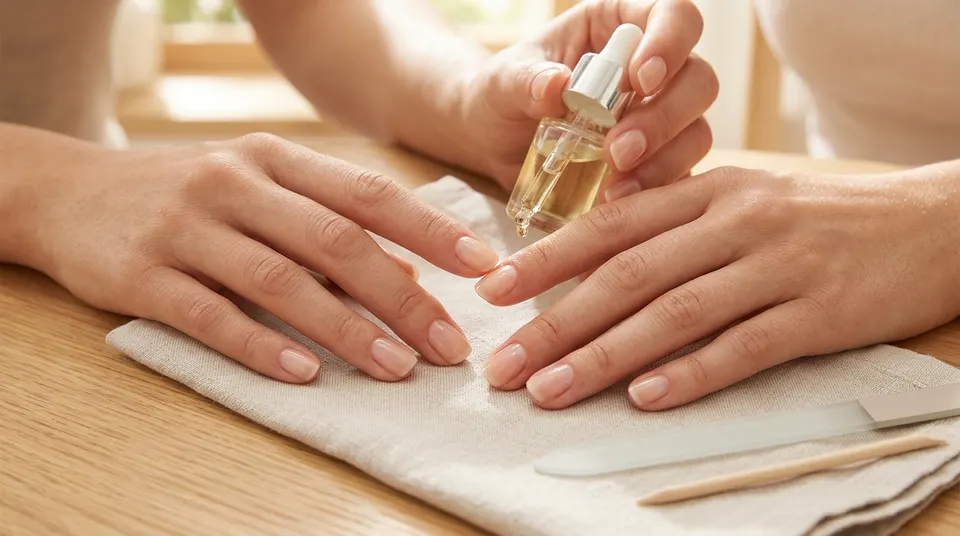
Cuticle maintenance should focus on moisturising and gentle pushing, not cutting. Apply cuticle oil (jojoba oil, vitamin E, squalane) daily to keep the cuticle flexible. Use a wooden or rubber cuticle pusher, not a metal one, and push only what is already loose — do not force the cuticle back. If you cut cuticles, cut only the dead, loose pieces that lift away easily, not the living skin that is attached.
Cuticle removers contain mild alkalis (potassium hydroxide, sodium hydroxide) that dissolve dead skin cells. They are effective but can irritate the living skin if left on too long or used too frequently. Limit use to once per manicure cycle, rinse thoroughly, and follow with cuticle oil.
Nail Treatments: Realistic Expectations
Base coats serve two functions: they prevent pigment from colored polish from staining the nail plate, and they improve adhesion between the polish and the nail. A good base coat can reduce peeling and chipping regardless of whether it contains strengthening ingredients. The adhesive function matters more than the ingredient list for most users.
Top coats protect the polish layer from chipping and UV damage. Quick-dry top coats use solvents that evaporate rapidly, hardening the polish layer faster. Gel-effect top coats add gloss and thickness. Neither affects the nail plate itself.
Gel polish and UV curing harden through photopolymerisation — a chemical reaction triggered by UV or LED light. The advantage is durability: gel polish lasts two to three weeks without chipping. The disadvantages are the removal process and cumulative damage. Gel polish must be soaked off in acetone, which dehydrates the nail plate. Mechanical removal (filing, scraping) damages the plate surface. Over several months of continuous gel use, the nail plate becomes thinner, more brittle, and more prone to peeling. Taking breaks of one to two weeks between gel cycles allows the nail to rehydrate and recover.
Dip powder systems use a cyanoacrylate-based adhesive with a colored powder. They are more durable than regular polish but harder to remove. The removal process involves soaking in acetone, often with mechanical filing, which causes similar dehydration and surface damage as gel removal. Dip powder is not inherently safer than gel — the risk comes from the removal process, not the application.
Acrylic nails and nail extensions involve attaching a plastic structure to the natural nail plate. The natural nail must be filed to create a rough surface for adhesion, which permanently removes the nail plate's outer layers. Over time, this weakens the natural nail, and removal often leaves the nail thin and damaged. Acrylics are a cosmetic choice, not a nail health treatment. The natural nail needs a recovery period after removal before it returns to its baseline strength.
Common Nail Concerns and What They Indicate
Brittle, splitting nails are most commonly caused by repeated wet-dry cycles — washing hands frequently, using nail polish remover, or prolonged water exposure. The nail plate swells when wet and contracts when dry, creating microscopic cracks that propagate over time. The fix is to reduce wet-dry cycling and apply a moisturising oil after each hand wash.
Peeling nails (lamellar dystrophy) occur when the layers of the nail plate separate. This is often caused by dehydration, over-filing, or acetone exposure. The nail grows in layers, and if the intercellular cement between layers is weakened, the layers separate. Protein treatments and biotin supplementation may help, but the primary fix is reducing dehydrating exposures.
Yellow or discolored nails can result from staining (dark nail polish, smoking, henna), fungal infection, or — rarely — systemic conditions. Staining grows out with the nail. Fungal infections cause thickening, crumbling, and yellow-white discoloration, often with an odour. Fungal nail infections require medical treatment — topical antifungal lacquers or oral antifungals — and can take months to resolve because the infected nail must grow out completely.
White spots (leukonychia) are almost always caused by minor trauma to the nail matrix, not by calcium deficiency or nutritional issues. A bump, a pinch, or aggressive cuticle pushing damages the matrix temporarily, and the resulting nail plate grows out with a white spot. The spot moves forward as the nail grows and is clipped off at the free edge. No treatment is needed.
Vertical ridges become more common with age. They are caused by variations in cell production in the aging nail matrix and are a normal part of nail aging, not a sign of deficiency. Ridge-filling base coats smooth the surface for polish application but do not change the nail structure.
What to Watch For: When Nail Changes Matter
Most nail changes are cosmetic and harmless. But some patterns warrant medical evaluation:
Thickened, crumbling nails — likely fungal infection. Needs medical diagnosis and treatment.
Nail separation from the bed (onycholysis) — can be caused by trauma, fungal infection, psoriasis, or thyroid disease. If it appears without a clear cause, a doctor should evaluate it.
Dark bands or streaks on the nail — especially if they grow or change shape. These should be evaluated to rule out subungual melanoma, a rare but serious form of skin cancer under the nail.
Pitting or crumbling of the nail surface — often associated with psoriasis. Can appear in people who do not have visible psoriasis on their skin.
Redness, swelling, or pain around the nail — signs of infection (paronychia). Requires treatment to prevent spread to the matrix.
Compact Takeaway
Nails are dead protein. They cannot be strengthened topically — products change flexibility, hydration, or surface appearance but do not alter the internal structure. The living parts of the nail unit (matrix, cuticle, nail bed) determine nail health and should be the focus of care. Cuticles are protective seals, not something to remove. Nail strengtheners work through different mechanisms — formaldehyde hardeners reduce flexibility (useful for soft nails), while moisturising and protein treatments support resilience. Repeated wet-dry cycling is the most common cause of brittle nails, and reducing it is more effective than any product. Supplements like biotin can help for people who are below optimal levels but take months to show results. Nail changes that involve thickening, separation, dark discoloration, or infection signs warrant medical evaluation, not cosmetic treatment.