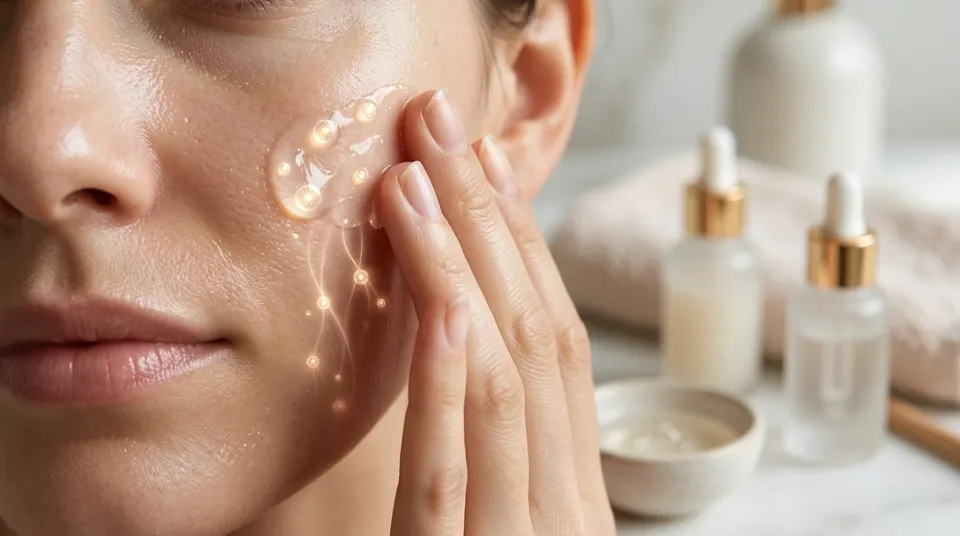
What Peptides Are and How They Work
Peptides are fragments of proteins — short chains of amino acids linked by peptide bonds. When a protein breaks down naturally in the skin, the resulting peptide fragments act as signals that tell cells to produce more of the structural proteins that were broken down. Topical peptides aim to mimic this natural signalling process.
The key distinction is mechanistic: retinoids and vitamin C enter skin cells and directly alter their behaviour. Peptides do not enter cells — they bind to receptors on the cell surface, triggering a signalling cascade inside the cell. This indirect mechanism is why peptide results are typically more subtle and slower to appear than retinoid results, but also why peptides cause virtually no irritation — they do not interfere with cellular processes directly.
The practical implication is that peptides work with the skin's existing biology rather than overriding it. This makes them a gentler option for anti-aging support, but also means they cannot produce the magnitude of change that a retinoid can in a compromised or aged skin.
Types of Peptides and Their Functions
Not all peptides do the same thing. The term "peptide" on a label is as broad as "vitamin" — it tells you the category, not the specific function. The main functional types are:
Signal Peptides
Signal peptides mimic the fragments produced when collagen breaks down naturally. They tell fibroblasts — the cells in the dermis that produce collagen, elastin, and other structural proteins — that collagen has been damaged and more needs to be made. The best-studied signal peptide is palmitoyl pentapeptide-4 (Matrixyl), which has been shown in controlled studies to increase collagen production and reduce wrinkle depth over 8 to 12 weeks. The effect is modest — typically a 10-20% improvement in wrinkle depth measured by silicon replicas — but statistically significant and reproducible across multiple studies.
Palmitoyl tripeptide-1 and palmitoyl tetrapeptide-7 (Matrixyl 3000) are a commonly paired combination that signals both collagen production and reduced inflammation. The tetrapeptide component reduces the release of inflammatory cytokines, which complements the collagen-stimulating effect of the tripeptide. This pair appears in many anti-aging products and has the strongest cumulative evidence after Matrixyl alone.
Carrier Peptides
Carrier peptides transport trace minerals — particularly copper and manganese — to sites where they are needed for enzymatic reactions. The most studied carrier peptide is copper peptide GHK-Cu (glycyl-L-histidyl-L-lysine-copper). Copper is a co-factor for several enzymes involved in collagen synthesis and wound healing, and GHK-Cu delivers it directly to skin cells.
GHK-Cu has been studied for wound healing and skin regeneration, with some evidence that it increases collagen production, reduces inflammation, and promotes blood vessel growth in healing tissue. In cosmetic concentrations (typically 0.1-1%), the effects are modest but measurable. GHK-Cu can be irritating when used alongside retinoids or exfoliating acids because the copper ions can catalyse oxidation reactions on the skin surface — it is best used in a separate routine step rather than combined with strong actives.
Neurotransmitter-Inhibiting Peptides
These peptides — most notably acetyl hexapeptide-8 (Argireline) — work by mimicking the action of botulinum toxin at a much weaker level. They interfere with the release of acetylcholine at the neuromuscular junction, reducing the intensity of muscle contractions that cause expression lines on the forehead and around the eyes.
The effect is real but far weaker than Botox. Studies show a 20-30% reduction in wrinkle depth over 30 days of twice-daily use — visible in before-and-after photographs but not comparable to the 80-100% reduction produced by injectable botulinum toxin. Argireline works best for fine expression lines that are just beginning to form, not for established deep wrinkles.
Enzyme-Inhibiting Peptides
These peptides interfere with enzymes that break down structural proteins in the skin — particularly matrix metalloproteinases (MMPs), which degrade collagen and elastin during UV exposure and inflammation. By slowing this breakdown, they help maintain existing collagen rather than stimulating new production.
The evidence for enzyme-inhibiting peptides is weaker than for signal peptides, and few standalone studies support their efficacy at cosmetic concentrations. They are most useful as supporting ingredients in a broader anti-aging formulation rather than as the primary active.
What the Evidence Actually Shows
The peptide category has a specific problem: the term is used so broadly that products containing a trace amount of any peptide can claim "anti-aging peptide technology" regardless of whether the peptide is present at a meaningful concentration or belongs to a type with supporting evidence.
Studies that show statistically significant results use specific peptides — palmitoyl pentapeptide-4, copper GHK-Cu, acetyl hexapeptide-8 — at concentrations of 0.5% to 3% of the active peptide. Products listing a single peptide near the bottom of the ingredient list, or using a proprietary blend whose concentration is undisclosed, are not supported by the same evidence.
The practical reading: look for a named peptide (not just "peptide complex") in the middle of the ingredient list — after the first five or six ingredients but before the preservatives. If the only peptide is at the very end of the list, the concentration is negligible and the anti-aging claim is marketing, not science.
How to Use Peptides in a Routine
Peptides work best alongside retinoids, not instead of them. Retinoids stimulate collagen production directly by binding to nuclear receptors. Peptides support collagen production indirectly through surface signalling. The two mechanisms are complementary — using both produces better results than either alone, provided the barrier is managed.
Apply peptides to clean skin. Like most active ingredients, peptides penetrate best when nothing interferes. Apply after cleansing, before heavier creams. If using multiple peptide-containing products, choose one with multiple peptide types rather than layering separate products — the total peptide concentration matters more than the number of products applied.
Avoid combining copper peptides with strong acids or retinoids in the same routine step. Copper ions can catalyse oxidation, which reduces the efficacy of L-ascorbic acid and can increase irritation from retinoids. Apply copper peptides in a separate routine (one in the morning, one at night) or on alternating days.
Be patient. Peptide results appear on a scale of months, not weeks. Studies showing visible wrinkle reduction typically last 8 to 12 weeks. The change is gradual and cumulative — you may not notice it day to day, but a comparison at three-month intervals should show measurable improvement in firmness and fine line depth.
Common Misconceptions
"All peptides are anti-aging." Different peptides do different things. A moisturiser containing a single peptide at a low concentration is unlikely to produce visible anti-aging effects. The specific peptide type and concentration determine efficacy, not the presence of the word "peptide" on the label.
"Peptides are better than retinoids because they don't irritate." Peptides cause less irritation because they work through a gentler mechanism. But they also produce smaller effects. For someone willing to manage the retinisation process, a retinoid will produce more visible anti-aging results over the same time period. Peptides are an excellent option for people who cannot tolerate retinoids or want to supplement a retinoid routine — not a replacement.
"More peptides = better results." The relationship between peptide concentration and efficacy has not been established for most peptide types. Products containing five different peptides at trace concentrations are less likely to produce results than a product containing one well-studied peptide at a clinically relevant concentration. The number of peptides means little without knowing the type and amount of each.
"Peptides penetrate the skin easily." Peptides are relatively large molecules compared to retinol or vitamin C. Their penetration depends on molecular weight, the carrier system used, and the condition of the skin barrier. Formulators use penetration enhancers, encapsulation, and lipid carriers to improve delivery, but the fraction of applied peptide that reaches its target cells is a small percentage of the applied dose. This is why concentrations that look low in the ingredient list can still be effective — but also why a poorly formulated product may deliver virtually nothing regardless of the peptide content.
Compact Takeaway
Peptides are signalling molecules that communicate with skin cells to support collagen production, reduce inflammation, and — for neurotransmitter-inhibiting types — relax expression lines. Signal peptides (Matrixyl family) have the strongest evidence. Carrier peptides (copper GHK-Cu) support wound healing and repair. Neurotransmitter-inhibiting peptides (Argireline) provide a weak Botox-like effect. The evidence for peptides is real but modest compared to retinoids, and efficacy depends entirely on using the right peptide type at a meaningful concentration. Look for named peptides in the middle of the ingredient list, combine with retinoids for best results, and expect visible changes over months rather than weeks. For someone who cannot tolerate retinoids, a well-formulated peptide product is the best alternative — but it is not a replacement in terms of the magnitude of effect.