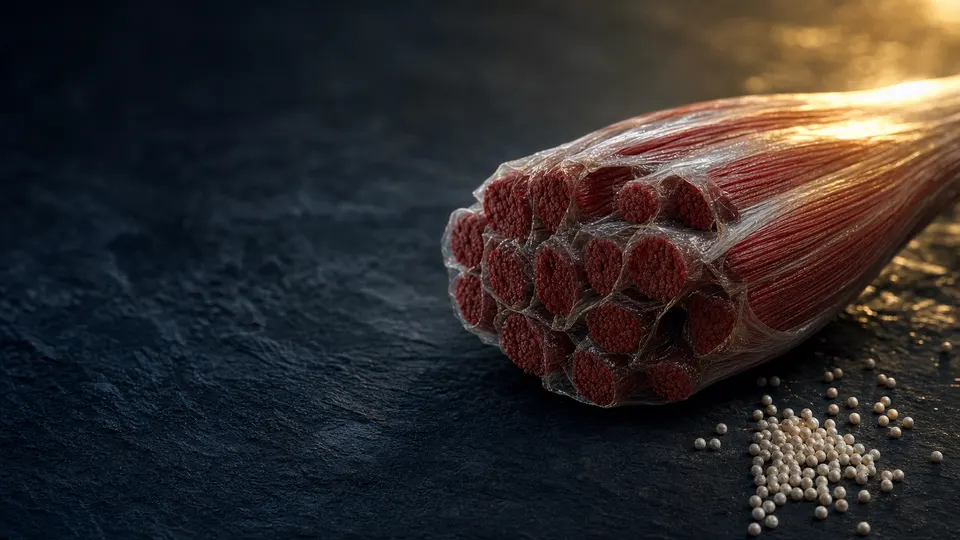
Why Protein Matters
Your body doesn't store protein the way it stores fat or carbohydrates. When the supply runs low, it breaks down muscle to keep critical functions running. This isn't a rare emergency — it's what happens whenever intake falls behind demand, even slightly. Your body prioritizes enzymes, immune cells, and hormones over biceps, because those systems keep you alive.
The body maintains a small, fast-turnover amino acid pool in the blood, and draws from it constantly to assemble muscle fibers, antibodies, enzymes, and repair tissue. The pool is small. It turns over quickly. And when it runs low, muscle is the first thing sacrificed to refill it.
How Protein Works
Protein is built from amino acids. Your body can produce some, but nine — the essential amino acids — must come from food. When you eat protein, digestion breaks it into individual amino acids that enter the circulating pool, where your body draws what it needs.
Among the essential amino acids, one stands out: leucine. Leucine is the primary trigger for muscle protein synthesis — the process that builds and repairs muscle. Without enough leucine reaching your muscles, the building signal doesn't fire, regardless of how much total protein you've eaten. This is why complete proteins — foods with all nine essential amino acids in useful amounts — have a practical edge. Animal foods (meat, fish, eggs, dairy) and a few plant foods (soy, quinoa, buckwheat) are complete. Most other plant proteins are low in at least one essential amino acid, often leucine or lysine.
This doesn't make plant proteins inferior. It means variety matters more when they're your primary sources — and it means the leucine threshold is something to be aware of when you're choosing what goes on your plate.
How Much and How Often
The RDA is 0.8 g per kilogram of body weight — roughly 56 g per day for a 70 kg adult. But the RDA was designed to prevent deficiency, not to optimize health. Many researchers consider 1.0–1.2 g/kg a more appropriate baseline for most adults, with 1.2–2.0 g/kg for people who are active, older, or recovering from injury.
Distribution matters, not just totals. Muscle protein synthesis has a per-meal ceiling driven by leucine: once enough reaches the muscle, the building signal peaks, and more protein at that meal doesn't further increase it. For most adults, this ceiling is reached at roughly 20–40 g of high-quality protein per meal. Older adults need more per meal to trigger the same response (anabolic resistance) — closer to 30–40 g.
Protein above this ceiling isn't wasted — your body uses it for enzymes, immune function, and energy. But for muscle specifically, one meal with 70 g doesn't give you the same benefit as two meals with 35 g each. Spreading intake gives you more consistent anabolic signals across the day.
In practical terms:
Aim for roughly 20–40 g of protein at each main meal
A palm-sized serving of meat, fish, or poultry is typically 20–30 g
A cup of cooked lentils is about 18 g; two eggs about 12 g; 150 g of Greek yogurt about 15 g
The pattern across the day matters more than any single meal's exact amount
The Package Deal
You're never eating protein in isolation — you're eating a food that contains protein, and that food comes with other things. The choice between animal and plant sources is partly about amino acids, but mostly about the total package.
Animal sources — meat, poultry, fish, eggs, dairy — deliver complete proteins with high leucine content and plenty of protein relative to calories. They also provide iron, B vitamins, and zinc in forms the body absorbs readily. The tradeoffs: some are high in saturated fat, and higher red and processed meat intake is associated with increased risk of colorectal cancer and cardiovascular disease.
Plant sources — beans, lentils, tofu, nuts, seeds, whole grains — come bundled with fiber, minerals, and phytonutrients that animal foods don't provide. They're typically cheaper. The tradeoffs: you need larger portions for equivalent protein, the iron and zinc are absorbed less efficiently, and no single plant source is complete. If you eat mostly or only plant proteins, variety isn't optional — you need to combine different sources (legumes with grains, soy regularly) to cover all essential amino acids.
Eating from both categories gives the broadest nutrient coverage. If you choose one, be intentional about what you're missing from the other.
What to Look For
Minimally processed protein foods are the everyday foundation. Canned fish, plain yogurt, eggs, tofu, beans, cheese, fresh meat and poultry — straightforward foods where protein is a natural component.
Ultra-processed protein products are a different category. Protein bars with long ingredient lists, many protein snacks, and flavored protein drinks often contain added sugars, emulsifiers, and other additives alongside the protein. A practical rule: if the ingredient list reads like a chemistry exam, it's an occasional choice, not a daily one.
Protein powders are useful when food-based protein is genuinely impractical — during travel, after intense training, or when appetite is low. They supplement food; they don't replace it. The fiber, minerals, and other nutrients in whole protein sources don't survive processing into powder.
Protein-to-calorie ratio is a useful comparison between similar products. Between two yogurts or two breads, the one with more protein and less added sugar is usually the better everyday choice. This is a tool for comparing similar items, not a rule for everything you eat.
Fiber comes standard with plant protein. Beans and lentils deliver both protein and fiber in one package. Animal proteins contain no fiber, so pairing them with vegetables or whole grains naturally rounds out a meal.
Common Misconceptions
"You need huge amounts of protein to build muscle." False. You need adequate protein plus strength training plus sufficient calories. More protein beyond what your body can use for muscle repair doesn't create additional muscle — the excess is oxidized for energy.
"Plant protein is incomplete, so it's inferior." Misleading. Individual plant foods may lack one or more essential amino acids, but eating a variety of plant proteins across the day covers all your bases. Rice and beans together form a complete profile, but so does eating lentils at lunch and whole grain bread at dinner. The variety across your week is what matters.
"Protein at every meal is essential." Close, but not for the reason people think. Total intake matters most, but because muscle protein synthesis has a per-meal ceiling, spreading roughly 20–40 g across meals gives more consistent muscle-building signals than concentrating protein at dinner. Distribution is a genuine optimization — not a requirement, but a meaningful one.
"Protein only matters if you're building muscle." False. Protein supports immune function, hormone production, wound healing, and bone density — not just muscle.
"More protein is always better." Not true. Beyond what your body needs, extra protein doesn't confer additional benefits and can displace foods that provide fiber, vitamins, and minerals. Adequate protein is what matters, not maximum.
"Too much protein damages your kidneys." Not in healthy people. In those with normal kidney function, higher protein intake does not cause kidney damage — this has been studied extensively. For people with existing chronic kidney disease, protein restriction is sometimes recommended, and those individuals should follow medical guidance. But the common worry that a high-protein diet will ruin healthy kidneys is not supported by evidence.
When Protein Deserves Extra Attention
Over 65. Older adults need more protein to counteract age-related muscle loss, and appetite often decreases with age. 1.2–1.5 g/kg is commonly recommended. Prioritizing 30–40 g per meal becomes more important, not less — anabolic resistance means the per-meal threshold is higher.
Pregnant, breastfeeding, or still growing. Protein needs increase to support tissue growth and development.
Recovering from illness or injury. The body's protein demand rises during healing.
Regular strength training. More protein supports muscle repair and adaptation. 1.4–2.0 g/kg is the typical range. Eating protein within a few hours of training takes advantage of the muscle's elevated sensitivity to amino acids.
Vegetarian or vegan. No single plant source is complete, so you need intentional variety — combining legumes with grains, including soy, and eating enough volume.
Managing hunger. Protein triggers satiety hormones and has a higher thermic effect than other macronutrients — your body burns roughly 20–30% of protein's calories just digesting it, compared to 5–10% for carbohydrates and 0–3% for fat. This makes protein-rich meals genuinely more filling.
When It Matters Less
If you regularly eat animal protein at most meals, you're almost certainly meeting your needs without tracking.
If you're sedentary and not trying to change body composition, the difference between 0.8 and 1.2 g/kg is modest in practical terms.
A single low-protein meal doesn't matter. The pattern across days and weeks is what counts.
The Takeaway
20–40 g of protein per meal, from varied sources. More than that at one sitting doesn't further help your muscles. Less than that across the day means your body may break down muscle to keep other systems running. Spread it, vary it, and pay extra attention if you're older, active, or eating mostly plants.