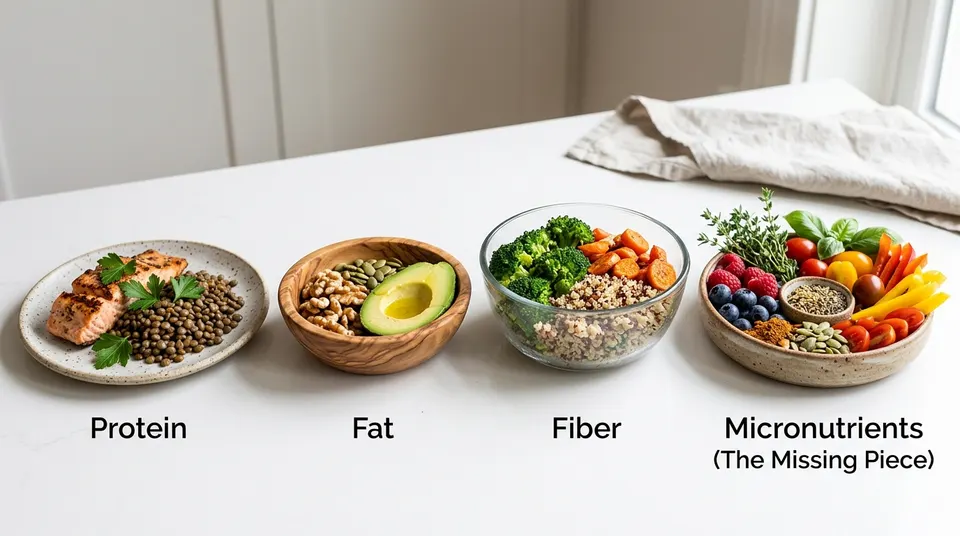

Three Levers, One Job
Pair carbohydrates with protein, fat, or fiber at every meal. This is the single rule that does most of the energy work. This article focuses on protein and fat — the two levers most people underuse. Each slows the same meal from a different angle, and understanding the mechanisms tells you how much of each you need, when each matters most, and which one to add when the meal is missing one.
There's a third factor most nutrition writing misses entirely: the micronutrient cofactors — vitamins and minerals that your cells need to actually use the energy you eat. You can eat enough calories, enough protein, enough fat, and still feel flat because those cofactors are short. And there's a fourth lever that's faster than all the others: hydration. This article covers all four.
Protein: The Strongest Lever
Protein is the single most effective food for keeping your energy stable after a meal. It works through three mechanisms that pure carbohydrates don't activate — one hormonal, one mechanical, and one through gut hormones that signal fullness.
The first is hormonal. When you eat carbohydrates alone, your pancreas releases insulin — the hormone that clears glucose from your blood. That's one signal, pulling in one direction. When you eat protein, your pancreas releases insulin and a second hormone called glucagon.
The problem with carbohydrates alone isn't that glucose goes up — that's supposed to happen. The problem is that insulin often pulls it down too hard, below where you started. That dip below your starting point is what you feel as a crash: shakiness, hunger, low energy an hour after eating.
Think of insulin and glucagon as two people on a seesaw. Insulin lowers blood glucose. Glucagon tells your liver to release a small amount of stored glucose, which lifts it slightly. They pull in opposite directions at the same time. The result isn't that glucose stays high — it's that insulin doesn't overcorrect. Glucose still comes down, but gradually, without the dip that triggers a crash. The seesaw settles smoothly instead of swinging hard in one direction.
This is the single most important thing to understand about protein's role in energy. It's not just that protein is good for you. It's that protein gives your body a second hormonal lever that pure carbohydrates don't activate.
The second mechanism is mechanical. Your stomach is a gatekeeper — it doesn't dump everything into your intestine at once. It releases food gradually through a valve between your stomach and your intestine. This process is called gastric emptying, and it's the rate at which food leaves the stomach. When protein is present, the stomach holds onto the contents longer, slowing gastric emptying. This means glucose from any carbohydrates in the same meal enters your bloodstream more slowly.
Together with the glucagon counterbalance, this creates a two-part effect: protein slows how fast glucose enters the blood, and provides a hormonal counterweight to the insulin that clears it.
The third mechanism is good news if you get hungry between meals. When protein reaches your intestine, specialized cells there release hormones that do two things: they help your body match insulin release to the glucose that's actually arriving, and they send a fullness signal to your brain.
One of these hormones is called GLP-1 (glucagon-like peptide-1). Despite the name, it is not the same as glucagon — they are different hormones with different jobs. GLP-1 is one of the hormones doing the two things just described: it fine-tunes insulin release to match the glucose arriving from your meal, and it sends a fullness signal to your brain. You may have heard of it because it is the target of several current weight-loss medications, which work by amplifying these same effects. Your body produces GLP-1 naturally after a protein-rich meal. Protein triggers more of these gut hormones per calorie than either carbohydrates or fat.
The result is a meal that produces a gentler glucose curve, keeps you satisfied longer, and reduces the likelihood of the crash-and-crave cycle.
An honest note on animal versus plant protein: animal proteins typically trigger a stronger response from these gut hormones than plant proteins. The difference is partly that animal proteins have higher concentrations of certain amino acids — one in particular, called leucine, is a potent fullness trigger — and partly that animal proteins are easier to digest. Plant proteins contain all the same amino acids, but some are present in smaller amounts, which is why eating a variety of plant protein sources matters. Plant proteins still trigger the same hormonal response, just less intensely per gram. If you rely primarily on plant sources, you may need slightly more total protein to achieve the same energy-stabilizing effect.
Fat: The Complementary Lever
Fat slows down how fast carbohydrates enter your bloodstream — through the same gatekeeper mechanism as protein, but triggered by a different hormone. It also serves as your body's between-meal fuel, which is why you don't wake up at 3 a.m. desperate for food: your body fat stores months of energy, and you shift to burning it between meals and overnight. But the part that matters for meal-time energy stability is the slowing effect.
When fat arrives in your intestine, it triggers a fullness hormone from specialized cells there. This hormone sends a fullness signal to your brain through the nerve connecting your gut and your brain. Critically for energy stability, it also tells the valve between your stomach and your intestine to open less frequently and release smaller amounts.
Here's the full chain: fat arrives in your intestine → your intestine releases a fullness hormone → that hormone tells your stomach's exit valve to slow down → food leaves the stomach more gradually → glucose from any carbohydrates in the meal enters your bloodstream more slowly. The same pasta with olive oil produces a lower glucose peak than the same pasta plain. Fat doesn't change what the carbohydrates are. It changes the speed at which they arrive.
Fat also enables the absorption of fat-soluble vitamins. Vitamins A, D, E, and K dissolve in fat, not water. Without fat in the digestive tract, your body absorbs much less of these vitamins from the same meal. For energy specifically: vitamin D helps your mitochondria — the energy-producing structures inside your cells — work efficiently, and vitamin E protects those same structures from wear. Fat in a meal isn't just about glucose stability. It's also delivering the vitamins that keep your energy machinery running.
For energy stability, protein is the stronger lever per gram. Here's why: protein gives you both the hormonal counterbalance (the glucagon seesaw) and the stomach-slowing effect. Fat gives you the stomach-slowing effect and the between-meal baseline fuel, but not the counterbalance. Add protein first, then fat. The two together produce a flatter, longer curve than either alone — protein and fat each slow the stomach through different hormones, and both send fullness signals.
The threshold for each: roughly 20–30 g of protein and 10–15 g of fat per main meal for meaningful energy stabilization. What does that look like on a plate? Twenty grams of protein is about two eggs and a yogurt, or a cup of lentils. Thirty grams is a chicken breast or a fish fillet. Fifteen grams of fat is a tablespoon of olive oil, a quarter of an avocado, or a small handful of nuts. Below these amounts, the effects are present but weaker. Beyond them, the relationship flattens — more isn't dramatically better.
Component | Threshold | Example sources |
Protein | 20–30 g | 2 eggs + Greek yogurt (~20 g); chicken breast or fish fillet (~30 g); 1 cup lentils (~18 g) |
Fat | 10–15 g | 1 tbsp olive oil; ¼ avocado; small handful of nuts; fat in eggs or full-fat dairy |
The Missing Piece: Micronutrients as Energy Cofactors
You can eat enough calories, enough protein, enough fat, enough fiber. On paper, your diet provides everything your body needs to produce energy. And yet you feel flat — not crashing dramatically, just running at reduced capacity. Fuel doesn't ignite itself. It needs a spark. The spark comes from vitamins and minerals that most discussions of energy completely ignore.
B vitamins: the keys that unlock your fuel
Your cells convert the food you eat into ATP — the molecule your body actually uses for energy. This process happens in stages, and each stage has a gate. At each gate, a specific protein performs a specific chemical transformation. Most of those proteins cannot function without a B vitamin attached to them. Think of B vitamins as the keys that unlock each gate — without the right key, the gate stays shut and the process stalls.
Vitamin | Role in energy metabolism | Where it's found |
B1 (thiamin) | The key for the gate that lets glucose breakdown products enter the mitochondria. Without it, glucose metabolism stalls before ATP is made. | Whole grains, legumes, pork, sunflower seeds |
B2 (riboflavin) | Carries electrons in the final stage of energy production, where most ATP is made | Dairy, eggs, leafy greens, almonds |
B3 (niacin) | Carries electrons in the same final stage, alongside B2 | Meat, fish, whole grains, peanuts |
B5 (pantothenic acid) | Helps build the molecule that carries fuel fragments — from carbohydrates, fat, or protein — into the energy-producing cycle | Widespread; liver, avocado, mushrooms, eggs |
B6, B12, folate | Required for red blood cell production; deficiency reduces oxygen-carrying capacity and ATP production | B6: poultry, fish, potatoes; B12: animal foods only; folate: leafy greens, legumes |
The processing problem ties these together, and it's bad news for anyone eating a diet centered on refined foods. Refining grains removes the bran and germ — the parts where B vitamins, vitamin E, iron, magnesium, and zinc are concentrated. What remains is mostly starch. Fortification adds back some of what was removed — B1, B2, B3, folate, and iron — but not B5, B6, magnesium, or vitamin E. A diet centered on refined grains and ultra-processed foods can meet your calorie needs while delivering less than optimal amounts of the micronutrients those calories require to be converted into ATP. The result: enough calories, but not enough cofactors to turn them into usable energy.
Iron: the oxygen supply chain
Your cells need oxygen to produce energy, and iron is what carries that oxygen through your blood.
Iron sits inside hemoglobin — the protein in red blood cells that picks up oxygen from your lungs and delivers it to every tissue. Each hemoglobin molecule contains four iron atoms, and each iron atom grabs one oxygen molecule.
Here's the full chain when iron is short: you produce fewer red blood cells → each cell carries less oxygen → your cells receive less oxygen → your mitochondria can't produce ATP at full capacity → you feel tired. The effect is direct: your energy production is throttled because the oxygen supply has been throttled.
Iron deficiency is the most common nutritional deficiency worldwide, affecting roughly 1 in 4 people — and more among menstruating people, pregnant people, and those eating predominantly plant-based diets. A ferritin blood test is the reliable way to check your iron stores.
Magnesium: the energy currency itself
Every molecule of ATP in your body is actually Mg-ATP — ATP bound to a magnesium ion. The magnesium is like the handle on a tool: it's what allows your cells to grab and use the ATP molecule. Without magnesium, your body can produce ATP, but your cells can't effectively use the energy it contains. It's the difference between having fuel in the tank and having a working engine to burn it.
Magnesium also participates in over 300 chemical reactions in your body, including several in the energy-production process itself — but its role in ATP is the most fundamental of all.
Magnesium deficiency produces a distinctive kind of fatigue — often accompanied by muscle tension, cramps, or restless sleep, because magnesium also regulates muscle relaxation and nervous system excitability. The combination of fatigue and tension is a useful signal that magnesium, rather than iron or B vitamins, may be the shortfall.
When Food Is Enough — and When It Isn't
For most people eating a varied diet that includes whole grains, legumes, vegetables, and some animal products, micronutrient intake for energy production is adequate. Specific situations change this.
Vegan diets require reliable B12 from fortified foods or supplementation. No plant source provides it in absorbable, reliable amounts. Deficiency develops over years and the neurological damage can be irreversible by the time symptoms appear.
Heavy menstrual bleeding increases iron loss and can produce iron deficiency even with adequate dietary intake.
Regular alcohol consumption impairs absorption of B1 and folate and increases urinary magnesium excretion.
Digestive conditions (celiac, Crohn's, ulcerative colitis) reduce absorption of iron, B12, and magnesium.
Long-term acid-reducing medications impair absorption of iron and magnesium.
If you're in one of these categories and experiencing persistent fatigue despite reasonable food choices, a blood test is more useful than guessing. The relevant tests: ferritin for iron stores, serum B12, RBC magnesium.
Hydration: The Immediate Lever
Hydration is the most immediate energy lever available, and the one most often overlooked. A glucose crash takes 60 to 120 minutes to develop. Dehydration can produce measurable fatigue and cognitive slowing within hours — and the fix takes minutes.
Here's why dehydration hits so fast. The liquid part of your blood is roughly 92% water. When your blood volume drops → your heart pumps less blood with each beat → less oxygen reaches every tissue, including your brain → you feel foggy and slow. At just 1 to 2% body mass loss from water — roughly 0.7 to 1.4 liters for a 70 kg person, easily reached on a warm day without drinking — cognitive performance measurably declines: reaction time slows, attention degrades, subjective fatigue rises.
One hydration-meal interaction worth knowing: drinking a large volume of water immediately before a meal can speed up gastric emptying, slightly undermining the effect of protein and fat. Here's why: water fills the stomach → stretch receptors detect the extra volume → they signal the exit valve to open → food leaves the stomach sooner than it would have. Sipping with a meal is fine. Chugging about two glasses (500 ml) right before eating won't fully undo the protein and fat effect, but it takes some of the edge off their slowing benefit.
Practical patterns: front-load water in the morning (you wake mildly dehydrated from overnight breathing); sip with meals rather than chugging; taper before bed. Urine color tells you more than thirst does. Caffeinated drinks still hydrate you at typical intake levels — the mild diuretic effect of caffeine doesn't outweigh the water they contain.
What to Take Away
Three things from this article that you won't find in most energy discussions.
Protein's secret is the seesaw. When you eat protein, your pancreas releases two hormones that pull in opposite directions — insulin lowering blood glucose, glucagon preventing insulin from pulling it too far down. This means glucose comes down gradually instead of crashing. Pure carbohydrates only trigger insulin, with nothing to prevent the overcorrection. That's what makes protein different, and why it's the strongest lever for stable energy.
You can eat enough and still feel flat. Your body needs specific vitamins and minerals to convert food into usable energy. B vitamins are the keys that unlock each stage of the process — without B1, glucose metabolism stalls before energy is made. Iron carries the oxygen your cells need to produce energy. Magnesium is literally part of the ATP molecule — without it, your body can make ATP but can't use it. A diet centered on refined and processed foods can deliver the fuel without these cofactors. The result is fatigue that food doesn't seem to fix. A ferritin test, serum B12, and RBC magnesium will tell you whether this is your situation.
Dehydration is the fastest-acting energy problem. A glucose crash takes an hour or two to develop after a meal. Sleep deprivation takes a night. Dehydration can degrade cognitive performance within hours — and the fix takes minutes. If you feel foggy and haven't had much to drink, water is the first intervention — before food, before caffeine, before anything else.