What a vegan diet changes
A vegan diet excludes all animal products—meat, poultry, fish, dairy, eggs, and honey—and builds entirely from plants. The reason for that choice varies; this article is about the nutritional consequences.
Removing animal products creates specific nutrient gaps. B12 deficiency causes nerve damage. Low iron drains energy. Insufficient iodine disrupts thyroid function. These aren't theoretical risks—they're well-documented outcomes of poorly planned vegan diets. The gaps are knowable and manageable, and each has a straightforward solution. But you do need to know about them.
One note on scope: this article addresses vegan nutrition for adults. Children and pregnant people have the same nutrient needs but narrower margins for error—the stakes for B12, iron, DHA, and calcium are higher, and professional guidance is more important.
The non-negotiable: Vitamin B12
B12 is produced by bacteria in soil and water. Animals accumulate it by eating and absorbing it throughout the food chain. That's why animal products contain B12 and unfortified plant foods largely don't—it's a food-system artifact, not a biological necessity of meat.
This is the one nutrient where a vegan diet genuinely requires a supplement. B12 deficiency causes nerve damage. It can take months or years to show symptoms, by which point some damage may be irreversible.
The practical pattern: Take a B12 supplement—daily or weekly, depending on the dose. Fortified foods (plant milks, nutritional yeast) can contribute, but getting enough from them requires eating precise amounts multiple times a day, which is easy to miss. A supplement costs very little and removes the uncertainty entirely.
Nutrients that need strategy
These nutrients are available from plant foods, but getting enough requires understanding how your body handles them. The mechanisms matter here—once you know why absorption varies, the strategies make sense rather than feeling like arbitrary rules.
Protein
Plant proteins are real proteins. Legumes, tofu, tempeh, nuts, seeds, and whole grains all provide protein. The difference is concentration and completeness.
Animal proteins contain all nine amino acids your body can't make (called essential amino acids) in proportions that match what your body needs. Most plant proteins are short in at least one—grains tend to be low in lysine, legumes tend to be low in methionine.
Why this matters less than it sounds: Your body doesn't assemble proteins meal by meal. It maintains a pool of amino acids from everything you've eaten across the day. As long as your overall diet includes a variety of protein sources, the gaps in one food are filled by another. Rice and beans together cover all nine amino acids—but so does rice at lunch and beans at dinner.
The practical pattern: Include a legume or soy product at two meals a day, plus nuts or seeds. This reliably covers protein needs without counting grams.
Iron
Iron from plants (non-heme iron) is absorbed less efficiently than iron from meat (heme iron). The reason is structural: heme iron is already bound in a form that gut cells recognise and take up directly through a dedicated receptor. Non-heme iron has to be converted to its absorbable form (Fe²⁺) before the gut can use it—and several compounds in plant foods work against that conversion.
What works against absorption:
Phytates (in whole grains and legumes) bind to non-heme iron and block uptake
Tannins (in tea and coffee) do the same
Calcium can compete for absorption when consumed in large amounts at the same meal
What helps: Vitamin C reduces non-heme iron to the absorbable form and keeps it stable through the stomach. This isn't a minor boost—pairing iron-rich foods with vitamin C can increase absorption several-fold.
The practical pattern: Eat iron-rich plants (lentils, beans, spinach, tofu) with a vitamin C source (tomatoes, citrus, bell peppers, leafy greens). Keep tea and coffee away from iron-rich meals—30 minutes before or after is enough. If fatigue or pallor suggest low iron, a blood test (serum ferritin) will tell you whether supplementation is needed.
Omega-3 fatty acids
Omega-3s exist in several forms. The plant version, ALA (alpha-linolenic acid), is found in flaxseeds, chia seeds, and walnuts. Your body converts ALA into two longer-chain forms: EPA and DHA.
DHA (docosahexaenoic acid) is the form concentrated in the brain and retina. It's critical for cognitive function and visual development. The conversion from ALA to DHA is very limited—typically under 5%. Your body prioritises converting ALA to EPA first, and the further step to DHA is inefficient, especially in people who consume a lot of omega-6 fatty acids (common in diets high in sunflower, soybean, and corn oils, which compete for the same conversion enzymes).
The practical pattern: Include a daily source of ALA—ground flaxseed (1 tablespoon), chia seeds, or walnuts. For DHA specifically, an algae-based supplement is the reliable option. Algae is where fish get their omega-3s in the first place—a supplement just skips the middleman.
Zinc
Zinc is present in legumes, nuts, seeds, and whole grains—but like iron, it's bound by phytates, which chelate (bind tightly to) minerals and prevent your gut from absorbing them.
Soaking or sprouting legumes and grains before cooking activates phytase, an enzyme that breaks phytates down. This is a traditional preparation step in many cultures, and it measurably improves mineral absorption.
The practical pattern: Include zinc-rich foods daily (legumes, pumpkin seeds, cashews, whole grains). Soaking dried legumes overnight before cooking is a simple habit that improves zinc and iron absorption simultaneously. Deficiency signs (slow wound healing, frequent illness, hair loss) warrant a blood test.
Simple habits that are easy to miss
These nutrients have straightforward solutions—single habits that close the gap. The risk isn't difficulty; it's not knowing the gap exists.
Iodine
Iodine is concentrated in seafood and dairy (dairy because iodine is used in cattle feed and teat disinfectants). Removing these foods drops iodine intake. Iodine is essential for thyroid hormones—without it, your thyroid can't produce the hormones that regulate metabolism, body temperature, and energy.
The practical pattern: Use iodized salt—a small daily amount covers the need. Alternatively, eat seaweed occasionally (nori, wakame—but not in large daily amounts, as iodine content varies wildly), or take a supplement.
Selenium
Selenium content in plant foods depends almost entirely on the soil they were grown in. European and UK soils tend to be low in selenium; North American soils are generally richer. The same food—a slice of whole-wheat bread or a serving of oats—can contain very different amounts depending on where it was farmed.
Animal products are normally reliable selenium sources because livestock feed is fortified. Remove them, and your intake depends on geography.
The practical pattern: One or two Brazil nuts a day provide enough selenium regardless of soil quality—each nut typically contains 50–90 µg. A handful daily can push intake well above safe limits, so this is a case where more is not better. If Brazil nuts aren't part of your routine, especially if your food comes from low-selenium soils, a supplement of 50–100 µg per day fills the gap.
Calcium and vitamin D
Calcium: use fortified plant milks, tofu made with calcium sulfate, leafy greens (kale and bok choy are reliable; spinach is high in calcium but also in oxalates, which block absorption), and tahini.
Vitamin D is not a vegan-specific issue—most people at higher latitudes don't get enough from food or sunlight, regardless of diet. If you need support, a supplement or levels check is the standard approach. See the foundational article for detail.
Building vegan meals
The balanced plate—roughly half vegetables and fruit, a quarter protein, a quarter whole grains, plus healthy fats—is covered in the foundational article. A vegan plate uses the same structure, with two shifts:
Protein comes from legumes and soy instead of meat. This is the main structural difference. Beans, lentils, chickpeas, tofu, and tempeh replace the protein quarter.
Fat sources shift toward plant oils, nuts, seeds, and avocado. This is mostly a label change—the foods are already vegan.
What's easier on a vegan plate: Fibre. Plant-based meals are almost automatically high in fibre—legumes, whole grains, vegetables, and nuts all contribute. You rarely need to think about fibre if your plate is built on whole foods.
What needs more attention: Calorie density. Plant foods are generally less calorie-dense than animal products. This is useful for managing weight but means you may need larger portions or more fat (nuts, avocado, olive oil) to feel satisfied, especially if you're active.
The fibre transition: If your previous diet was low in fibre and you shift to 40–50 g per day overnight, your gut will let you know—bloating, gas, discomfort. The bacteria in your colon that digest fibre need time to multiply. Ramp up over a few weeks, drink enough water, and the symptoms pass. This isn't a reason to avoid fibre; it's a reason to increase it gradually rather than all at once.
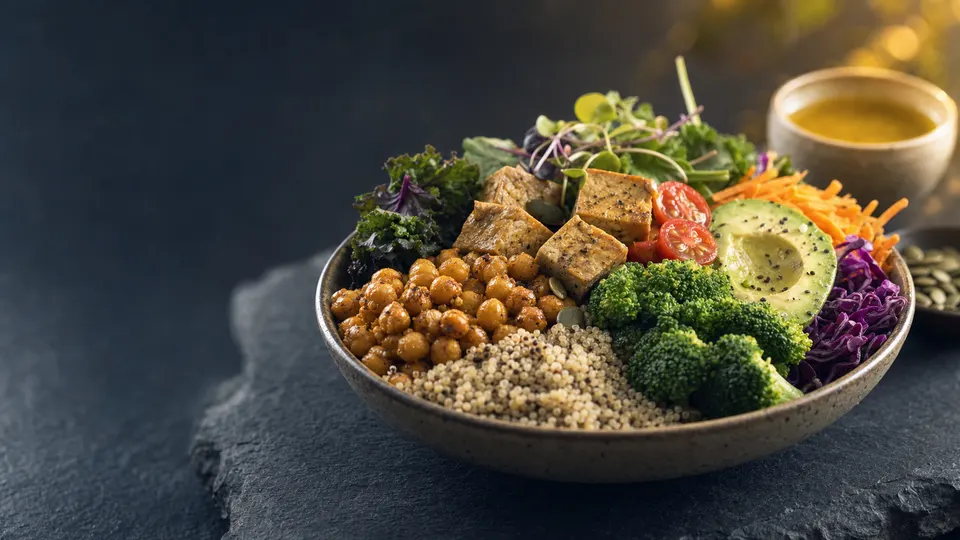
A pattern you can apply to any meal: Start with a vegetable base, add a legume or soy protein, include a whole grain, and finish with a healthy fat. This works whether you're making a grain bowl, a stir-fry, a soup, or a wrap. The specific ingredients change; the structure doesn't.
Two practical notes: a whole-food vegan diet is often cheaper than one centred on meat and dairy—beans, lentils, rice, oats, and seasonal vegetables are among the cheapest foods available (the expensive items are the processed substitutes). And eating out is easiest in cuisines built around plants: Indian, Ethiopian, Thai, Mexican, and Middle Eastern restaurants typically have multiple options without modification.
Processed vegan foods
The vegan aisle has expanded dramatically. Plant-based meat alternatives, vegan cheese, and specialty products are now common. Some are useful. Many are highly processed.
The useful end: Products made from whole-food ingredients—bean-based burgers, tofu sausages, seitan. These are recognisably made from foods you could prepare yourself. They're convenient without being engineered.
The problematic end: Ultra-processed meat analogues designed to mimic the texture, flavour, and mouthfeel of meat. These often contain isolated proteins, refined starches, high sodium, and a long ingredient list. They're lower in fibre and micronutrients than whole plant foods, and they don't offer the satiety of a meal built on legumes or whole grains.
When you do use them, check three things:
Sodium per 100 g—many exceed 500 mg, which is high for a single item in a meal
Fibre per 100 g—if it's under 3 g, it's not doing what whole plant foods would
Ingredient list—if it reads like a chemistry exam, it's an occasional choice, not a staple
The practical rule: Build your diet on whole foods—legumes, grains, vegetables, nuts, seeds. Use processed vegan products occasionally, not as your primary protein source. If you eat a plant-based burger every day, you're not eating a plant-based diet—you're eating a processed-food diet that happens to be vegan.
Physical activity on a vegan diet
Plant-based athletes compete at elite levels—but it doesn't happen automatically. A vegan diet makes three things easier to miss:
Carbohydrate intake. Plant diets tend to be carb-rich, which is good for endurance. But if you're eating a lot of high-fibre, low-calorie foods without enough grains and starchy vegetables, you can under-fuel. If energy drops during long sessions, the first thing to check is whether you're eating enough total carbohydrates.
Iron status. Athletes lose iron through repeated impact during running (foot-strike haemolysis, where red blood cells rupture from the pounding) and through sweat. Combined with the lower absorption of plant iron, endurance athletes on a vegan diet should monitor ferritin levels—not just haemoglobin, which can look normal while stores are depleted.
Protein timing. Total intake matters more than timing, but distributing protein across meals (rather than loading it at dinner) supports muscle protein synthesis more effectively. Include a protein source at every meal, not just one or two.
The takeaway
A vegan diet works when it's built on whole plant foods with deliberate attention to a handful of nutrients. The non-negotiable: B12 supplementation. The ones that need strategy: iron (vitamin C with meals, tea and coffee away from them), omega-3 DHA (algae supplement or consistent ALA), and zinc (soaking legumes). The ones that need a habit: iodine (iodized salt), selenium (one or two Brazil nuts), calcium (fortified plant milk, greens), and vitamin D (supplement or levels check—not vegan-specific).
Build meals from a pattern—vegetables, a legume or soy protein, a whole grain, and a healthy fat. Ramp up fibre gradually when starting. The pattern adapts to any cuisine, any budget, any schedule. Once the nutrient gaps are handled, the rest follows.