
Beyond Calories: What Food Really Does
It's tempting to reduce food to a single number: calories in, calories out. But food is not just fuel. It's the raw material your body uses to build and repair itself, the regulators that keep your systems running, and the compounds that protect you from damage.
Every bite does multiple jobs. The protein in your lunch becomes the enzymes that digest your next meal. The fat becomes part of your cell membranes. The vitamins unlock the chemical reactions that convert food into energy. When you understand these roles, the question shifts from "How many calories is this?" to "What does this food actually do for my body?"
This is the foundation for everything else in this course.
The Main Categories
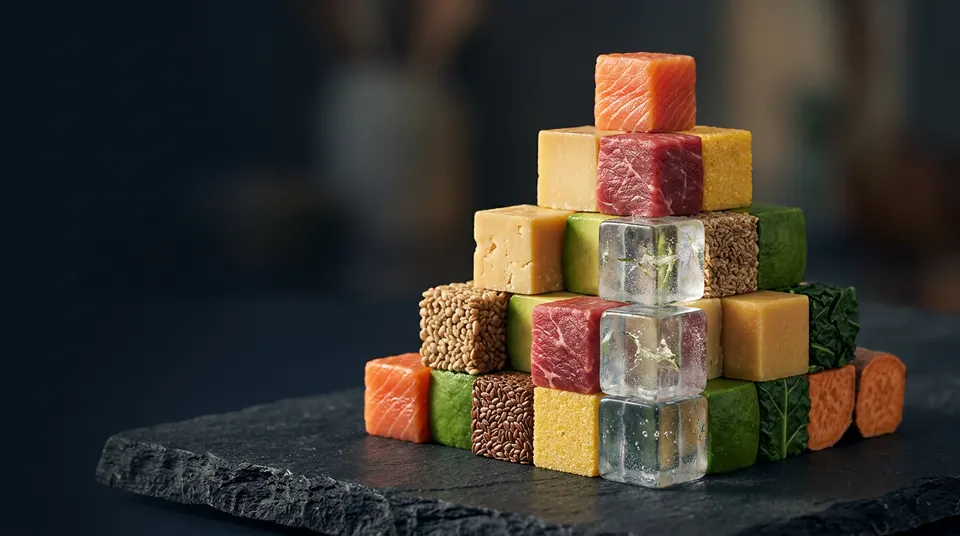
Food provides five categories of things your body needs, each with a distinct job:
Macronutrients — carbohydrates, proteins, and fats — provide energy and structural materials in larger amounts.
Micronutrients — vitamins and minerals — enable the chemical reactions that keep you alive, needed in smaller amounts.
Fiber — a carbohydrate your body can't digest, but that does critical work in your gut.
Water — the medium in which nearly everything in your body happens.
Food quality — whether your food is whole or highly processed — determines how well your body can access and use these nutrients.
Here's what each one actually does.
Macronutrients: The Big Three
Carbohydrates: Your Body's Preferred Fuel
Carbohydrates have one core job: they become glucose, the sugar your cells run on. What differs is how fast it gets there. Whole carbohydrates provide steady energy; refined carbohydrates and added sugars flood your system and trigger a crash. The mechanism behind this—and why it drives hunger—is outlined in Carbohydrates.
Proteins: The Builders
Proteins are made of amino acids — small molecules your body links together like building blocks. When you eat protein, your body breaks it back down into amino acids, then reassembles them into new proteins: muscle tissue, enzymes, hormones, antibodies, the structural framework of your skin and bones.
Your body can make some amino acids on its own. Others — called essential amino acids — must come from food. Animal sources (meat, fish, eggs, dairy) provide all essential amino acids in proportions closely aligned with human needs. Plant sources contain all essential amino acids too, but in different proportions — so eating a variety across the day covers the full set as effectively as animal sources.
Unlike fat or stored carbohydrate, your body has no reserve for amino acids. It uses what's available, or breaks down existing tissue to get the rest. That's why spreading protein across meals matters more than one large dose — your body is always rebuilding, and it needs a steady supply of raw materials. A practical rule: aim for a palm-sized portion at each meal.
Fats: Essential, Not the Enemy
Fats have been blamed for decades, but they're structurally essential. Every cell in your body is wrapped in a membrane made largely of fat. Your brain is roughly 60% fat. Many hormones — including the ones that regulate inflammation and blood pressure — are built from fatty acids.
Fat also makes other nutrients work: vitamins A, D, E, and K are fat-soluble, meaning your body absorbs them only when dietary fat is present. A salad dressed with olive oil delivers more of its nutrients than a bare one.
Sources of healthy fats include avocados, nuts, seeds, olive oil, and fatty fish. The type of fat matters — some fats (like trans fats) are clearly harmful, while others support health. We'll unpack the different types in a dedicated article.
Micronutrients: The Enablers
Vitamins and minerals don't provide energy — but without them, you can't unlock the energy from your food. They function as co-factors: molecules that allow chemical reactions to happen. If vitamins gave you energy, a multivitamin could replace breakfast. It can't — what they do is enable the reactions that convert food into usable fuel. Without them, the calories you eat can't do their job.
Iron, for example, is the core of hemoglobin, the protein that carries oxygen in your blood. Without enough iron, your cells can't get the oxygen they need to produce energy — regardless of how many calories you eat. Vitamin C is required to build collagen, the structural protein in your skin, joints, and blood vessels.
You get micronutrients from a wide variety of foods, especially fruits, vegetables, whole grains, and protein sources. A diverse diet — different colors, different plant families, different protein sources — is the most reliable way to cover the full spectrum. You don't need to track individual vitamins; the pattern of variety does the work.
Fiber: The Carbohydrate Your Body Can't Digest
Fiber is a type of carbohydrate your body can't break down — and that's exactly why it matters. Instead of being absorbed, it moves through your gut doing several jobs:
It forms a physical matrix in your digestive tract that slows how fast glucose enters your bloodstream — a speed bump for sugar absorption.
It adds bulk to stool, keeping digestion regular.
It feeds your gut bacteria, which produce beneficial compounds in return, including some that support immune function and reduce inflammation.
Most people don't get enough fiber. Good sources: fruits (especially with the skin), vegetables, whole grains, beans, lentils, nuts, and seeds. Including these foods regularly is one of the most practical upgrades you can make.
Water: The Unseen Foundation
Your body is roughly 60% water — and your blood plasma is about 90% water. That's not trivia; it's the reason water matters so much. Nearly every chemical reaction in your body happens in water. Nutrients dissolve in blood plasma to reach your cells; waste dissolves in it to be removed; sweat, which is mostly water, is how you cool down. When water volume drops, the medium itself becomes concentrated — and every process running in it slows down.
Losing just 1–2% of body water measurably affects concentration and endurance, which is why athletes pay close attention to hydration. For daily life, thirst is a reliable signal — drink when you're thirsty, and enough that your urine is pale rather than dark. Plain water is the best source. You also get water from fruits, vegetables, tea, and other beverages.
Food Quality: The Whole Package Matters
The form of your food matters as much as its nutrient content. Consider an apple versus apple juice. Both contain carbohydrates and some vitamins, but the whole apple comes with fiber and a cellular structure that slows sugar absorption. The juice strips both away — leaving a fast-digesting sugar drink that spikes blood glucose without the fullness or digestive benefits.
Whole, minimally processed foods deliver nutrients in their natural package: fiber that slows absorption, vitamins and minerals that work together, and a structure that naturally limits how fast you eat and how much. Highly processed foods have been broken down from their original state, stripped of fiber and many nutrients, and reconstructed with added sugars, excess sodium, and engineered fats. They're also designed to be hyper-palatable — easy to overeat without feeling satisfied, which is precisely the problem.
Highly processed foods as an everyday pattern clearly work against your health. They drive overconsumption, blood sugar instability, and long-term metabolic strain. This isn't about moralizing a single meal — it's about recognizing that the pattern you follow most of the time shapes your health outcomes.
What This Means in Real Life
Understanding what food does — beyond calories — changes how you evaluate choices. The right questions are practical ones:
Does this food usually leave me satisfied, or hungry again within an hour?
Does this choice support steady energy, or do I crash after it?
Am I getting a variety of whole foods most of the time?
These observations are more useful than any calorie count. They're how you build food intuition — the ability to make choices that work because you've learned what actually happens when you eat different things.
Food is information and building material, not just fuel. The five categories in this article give you a framework: each one has a distinct role, and each one changes how you feel. What you eat most of the time sets the pattern that matters — and now you have the vocabulary to notice what that pattern is actually doing.